
A Rainbow Blockchain: Optimising the Live Experience Economy
AUGUST 2026 | VERSION 8.2
Canonical current version. If a newer version is published on this page, every earlier copy is superseded.
Background
‘Lower-value human capital’ is being replaced in the tens of thousands by AI. Bill Winters, CEO of Standard Chartered Bank, has since had reason to qualify his turn of phrase, which for all the wrong reasons went viral globally — but the cat is out of the bag and all the canaries have stopped singing. University students, the canaries in the AI minefield, are now routinely booing guest speakers who present on AI. A recent King's College London survey finds a third of current students believe AI-related job losses will lead to social unrest.
Those who hope to halt or meaningfully regulate AI in response will be disappointed. A world that has always had rogue states — and probably always will — cannot constrain the development of what is becoming the most powerful tool in human history. To try would invite the ultimate sanction: oblivion or servitude at the hands of states that break the international rules to which they have nominally agreed. The list of conventions honoured more in breach than observance is long, and includes the Geneva Conventions (1949), the Chemical Weapons Convention (1993), the United Nations Charter (1945), and the Genocide Convention (1948). There is not one such convention that has not been broken in both letter and spirit by some nation.
It is unambiguously the case, therefore, that the best — and indeed the only — means of national defence is a full-throttle pursuit of AI's possibilities. AI will be developed. The only question is who develops it, and to what ends. This WhitePaper describes how and why ROCKR and ROCKRCOIN use AI to tip the balance in favour of the benign and the positive.
Notwithstanding this, social unrest is inevitable. It is not today at all clear that oblivion and servitude are not the destiny of many in any case.
The canaries in our universities are only the beginning. At the root of their anger is not merely the threat to their jobs and income. The deeper, anger-generating issue is triggered by phrases like lower-value human capital. It is as if their country only values them for the price at which their labour can be sold. If business, media, and government quantify human value primarily in terms of economic capital, and if that economic capital is being eroded by the development of a superior intelligence whose supply is seemingly becoming ubiquitous and infinite, then fear will only grow that most of human value and all of human hope — and especially collective young hope — is lost.
The solution to this malaise is obviously to think more deeply about the value of a human being but then to think more deeply still and create a plan to deploy practical solutions that expose those deeper values and quantify them and then use that refound value in such a way as to restore hope. ROCKR and ROCKRCOIN’s mission is to do just that.
So what is that deeper value precisely? The answer is the self-aware consciousness of humans and the unique GPS of that self-aware consciousness, especially when aggregated in a particular place and time.
Every human in the world is the owner of a unique self-aware consciousness, which the ROCKR apps enable them to surface, organise and aggregate with others and the ROCKRCOIN digital utility asset enables them to value, as an economic asset, in order to facilitate this aggregation through its live manifestation - in our towns, places, High Streets, schools, universities and venues - across the full spectrum of shared self-aware consciousness, namely any and every type of live experience genre and subject.
Today's AI-disrupted economy does not especially value this unique self aware consciousness. Tomorrow’s AI-empowered economy will have restored human’s unique self aware consciousness to the front and centre and foundational core of our world, empowered by ROCKR’s open source AI assisted applications and its Rainbow Digital Utility Asset ROCKRCOIN.
Is there a counter - argument? It is important to ask because if we are to build on the ROCK of human’s unique self-aware consciousness we should check that the rock is made of granite not sand. There are those in the scientific and AI community who state that AI will sooner or later attain self-aware consciousness as an emergent property of complex networks1. Were someone of faith to describe their belief that after the brain dies life continues as an emergent property of a complex network, they would be asked to describe the process but none would be forthcoming because they simply believe. Nor is any detail forthcoming from those who have faith in self-aware consciousness emerging in AI. They too are believers and this belief is widespread in science fiction and in popular imagination. Indeed such a view has probably contributed to our canaries ceasing to sing.
Are there any views in the academic community which challenge these beliefs? Yes. Oxford's Nobel Laureate in Physics, Sir Roger Penrose is one of several. Interpreting Gödel’s Incompleteness Theorems, he argues that humans are capable of non-computational thinking and AI, cannot. AI thinks only in a computational/algorithmic manner. Penrose argues further that non-computational thinking is the process by which humans attain self-aware consciousness. Self-aware consciousness is therefore not just different from AI. It is, by the structure of this argument, categorically beyond it, even as an emergent property. Is that a canary we can hear beginning to sing again? Not quite, yet.
The emotions that arise from self-aware consciousness — joy, sadness, love, grief, hope — persist in every individual. That persistence is what gives the universe meaning. The universe is being understood by us, to greater or lesser degree, but the understanding is real, present, and consequential in self-aware consciousness.
What humans - and especially the canaries - need to take from both sides of this argument today is not whether one side or other has it right - though the Penrose side has at least posited a rigorously argued academic position - but that self-aware consciousness is indeed special and we humans have it already. Further that while there are disputed reasons to believe that AI will never evolve non-computational capabilities, should it ever do so, then it will be special too, as opposed to humans no longer being special. Any body that gives meaning to the universe is, by definition, special.
So what is the value of being the means by which the universe has meaning? It is, self-evidently, the highest value of all. How can that value be manifested and made economic? By aggregation. If one conscious human is valuable, then a gathering of conscious humans is more so. The most precious asset in the world is therefore human presence brought together — in person, in real time, in a shared space where consciousness encounters consciousness. The process by which we aggregate our presence is therefore also valuable. The places where it happens are valuable. The economy in which it is transacted is valuable.
And it is precisely this economy — the live experience economy — that ROCKR and ROCKRCOIN are designed to manifest, cultivate, nurture and grow.
The remainder of this whitepaper describes the architecture, the economics, and the roadmap by which it is being built.
1. Executive Summary
ROCKRCOIN is a pioneering Rainbow Blockchain-based ecosystem designed to transform the global human-centric economy. By leveraging smart contracts, Dynamic Market Matching, verified non-anonymous identity, and a unique utility-driven digital asset, ROCKRCOIN aims to democratise access to live experiences, revitalise local economies, re-energise the High Street, liberate education from top-down curriculum to learner-curated procurement, and protect the value of human presence, skill, and craft in the age of AI and automation.
ROCKRCOIN also answers a gap the financial world is making more visible by the month. Across Europe, the institutions leading the tokenisation of finance are proving one half of every transaction — the money: a British bank has settled the purchase of a tokenised government bond with tokenised deposits on a public blockchain; a French bank has issued tokenised money-market funds on public blockchain infrastructure and is working toward atomic settlement, the security and the cash exchanged as a single indivisible unit; the Banque de France is piloting tokenised wholesale central-bank money. The other half — the entitlement: the ticket, the verified person, the participation that actually took place — has, as far as we have found, no proven equivalent anywhere. ROCKRCOIN is built to be that other half: the entitlement leg of the same transaction, held to the same standard of proof as the settlement leg the banks are already building.
Key features of the ROCKRCOIN Ecosystem:
A hybrid Market Clearing blockchain utilising Proof of Authority (PoA) / (PoS) consensus with mandatory non-anonymous identity verification.
A Rainbow tailored for positive societal impact, transparent network settlement, and a naturally expanding circular economy.
An open-source ecosystem of 30+ integrated applications (ROCKR apps) operated by independent hosters, all sharing the ROCKRCOIN blockchain.
A focus on curating, funding, and delivering live experiences across the full spectrum of human-centric activity: Education, The Arts, Community, Sport, High Street Retail and Health.
A utility-target monetary policy: new ROCKRCOIN issuance tracks real economic activity on the network, with no artificial issuance cap and no general-purpose monetary printing. Every unit issued corresponds to a verified unit of infrastructure or real activity work.
A free-floating utility asset: no peg, no value-maintenance undertaking, no investment claim — its value may fall as well as rise (Section 7.1).
A three-mode transaction architecture (native peer-to-peer settlement, pluggable P2P exchange, and market-maker point-of-sale) that eliminates custodial pooling and preserves the universal non-anonymous guarantee.
While identity-verified blockchains exist for enterprise consortia and regulated institutional asset trading, ROCKRCOIN is the first to apply universal protocol-level identity verification to a consumer-facing utility asset.
This combination — protocol-level mandatory non-anonymity, Proof of Activity, and a self-sustaining circular economy — defines ROCKRCOIN's structural distinctiveness as a utility asset.
2. The Rainbow Utility Asset Framework
2.1 The Seven Rainbow Characteristics
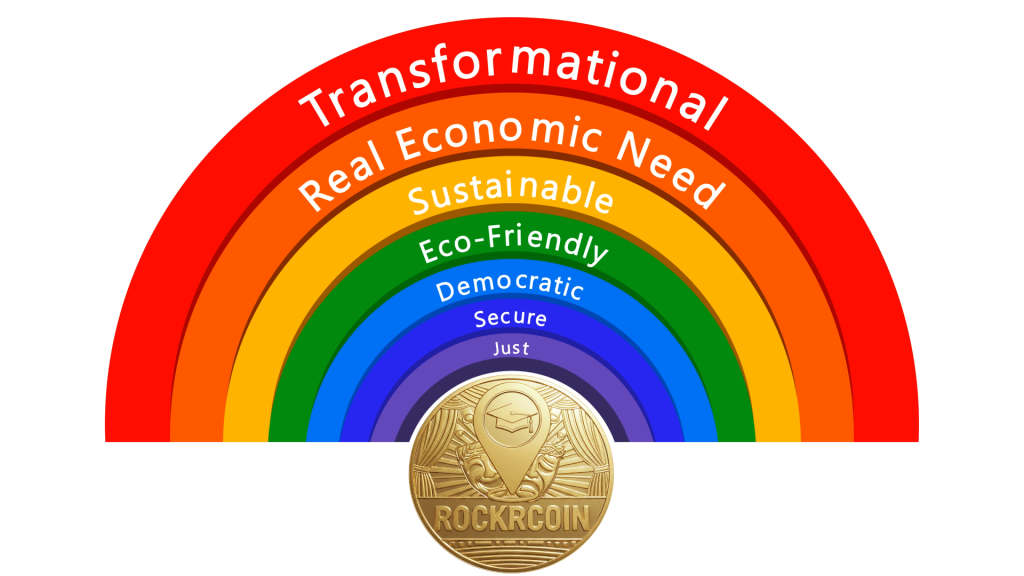
ROCKR and ROCKRCOIN are built on seven foundational characteristics — the colours of the Rainbow — each of which represents an architectural commitment, not an aspiration.
These 'Rainbow' characteristics serve a deliberate purpose. The everyday consumer who will use ROCKRCOIN need not read whitepapers or understand cryptography but they will recognise a rainbow where each colour is connected to one benign and affirmative architectural commitment, so the meaning lands that ROCKRCOIN is safe, ROCKRCOIN is good, ROCKRCOIN is built for them.
This Rainbow is ROCKRCOIN's safety symbol for the consumer economy:
Red: Transformational — Designed to disrupt the existing live experience economy by directly connecting Curators, Hosts, Venues, Performers, and Attendees through Dynamic Market Matching, eliminating intermediaries that extract value without adding it.
Orange: Real Economic Need — Addresses the friction, opacity, and risk that prevent live experiences from being created and funded efficiently. Spare capacity (unbooked venues, idle performers, Super Star teachers, vacant slots) becomes auctionable inventory.
Yellow: Sustainable — A monetary architecture that grows with the network's real economic utility, not with speculation. Each unit of ROCKRCOIN issued is tied to a verified unit of real work — infrastructure operation, identity verification, mediation, AI enrichment, or successful experience delivery.
Green: Eco-Friendly — Utilises a highly energy-efficient hybrid PoA/PoS consensus mechanism. No proof-of-work mining. The environmental footprint is a fraction of conventional blockchain networks.
Blue: Democratic — Employs an inclusive and representative governance model managed by a diverse based on verified Proof of Activity participation. Governance power is earned through genuine contribution to the ecosystem, not purchased. The open-source multi-instance architecture prevents centralisation — no single entity controls the network.
Indigo: Secure — Ensures transactional and systemic security through Automated Legal Agreements () and mandatory non-anonymous identity verification enforced at the protocol level. No wallet can hold, send, or receive ROCKRCOIN without a non-expired on-chain Decentralised Identifier () . Biometric liveness detection and document verification ensure real humans behind every wallet. This architecture also makes theft structurally unprofitable (see Section 4.2.1).
Violet: Just — Operates transparently within global regulatory frameworks with built-in data transfer and reporting capabilities. -compliant by design: no personal data on-chain, wallet independence from any single platform, and the right to delete profile data without losing earned assets. The non-anonymous principle ensures accountability — every participant in a live experience is a verified, real person.
2.2 Operational Mechanics
To execute this vision securely and sustainably, the ROCKRCOIN asset operates on the following technical principles:
Market-Driven Value: The exchange rate of ROCKRCOIN is determined exclusively by open market forces (supply and demand) and the volume of real-world services settled on the network. No peg, no fixed rate, no algorithmic price targeting.
Unit of Account Strategy: To protect suppliers from volatility during negotiation, contracts can be drafted using an external index (the IMF ) as a reference point which is linked to category depending upon where in the world the live experience is located. Settlement always occurs in ROCKRCOIN at the market rate at the moment of settlement. Settlement timing is a governance-published parameter earned by organiser standing (instant for the accredited, held-until-authentication for the unproven); issuance, by contrast, always follows authentication (Section 7.1.2).
Sector Specific: Purpose-built to handle high-frequency micro-settlements for tickets, talent, production, venue fees, supply chain payments, ecosystem commerce, and standard retail.
Utility-Target Issuance: The ROCKRCOIN Protocol algorithmically manages the issuance rate of tokens (not the price) to track the real economic activity growth of the network. New ROCKRCOIN enters circulation only as ROCKRCOIN compensating verified service providers — identity verification, escrow, validation, AI enrichment, and other infrastructure — for work that directly grows the network. This is described in detail in Section 7.1.
3. The Vision: Empowering the Human Economy
3.1 The Market Challenge
The live experience industry faces significant inefficiencies: transactional friction with high risk and slow settlement in live experience production2; pricing opacity making it difficult to determine fair market rates for talent and venues; hidden inventory is dead inventory where venues and performers remain unbooked due to market imperfection, rigid pricing and marketing risk; and a lack of unified infrastructure connecting creators, venues, and audiences with a guaranteed settlement layer.
3.2 Beyond Events: Retail as Live Experience
One of the core purposes of ROCKRCOIN is to catalyse the revival of the High Street. Retailers are incentivised to transform their shops into experience destinations: a cheese shop becomes a tasting experience, a bookshop hosts author readings, a hardware store runs woodworking workshops. A boarded up eyesore becomes a talking shop, a boutique theatre, a lecture space. All the retailers are in the business of inventing ways to invite their community to think about and answer the question ‘What Makes YOU ROCK?’. They are not merchants accepting cryptocurrency — they are ROCKR hosts.
Their suppliers — the cheesemaker, the publisher, the timber merchant, the teacher, the lecturer, the coach — are host-suppliers in the experience chain, exactly as host-performers, host-producers, directors, and stage crew are host-suppliers to a theatrical performance. The ecosystem taxonomy classifies all participants: Host-Performers, Host-Producers, Host-Suppliers, Venues, Attendees/Participants, Creators/Curators, Experience-Authenticators, and Blockchain-Consensus-Authenticators.
3.3 The Expanding Spectrum
This logic extends to every industry where human presence, skill, and accountability create value: Education, The Arts, Community, Sport, High Street Retail and Health. In the AI and robotics age, what remains economically valuable is the irreducibly human. ROCKR is designed to serve, protect and project that entire spectrum. The Red (Transformation) and Orange - Real Economic Need bands of the ROCKRCOIN Rainbow are not decorative — they represent the full spectrum of human economic activity that ROCKRCOIN is designed to serve.
In practice, there is no 'outside the ecosystem.' The ecosystem boundary expands organically as more participants join, until it encompasses the full supply chain of the human-centric economy, at the pinnacle of which is a human doing something, Live. Every person and business in that chain has an incentive to create a ROCKR profile because transacting within the ecosystem is not only the path of least friction but also the means by which the Post-AI Proliferation Economy values humans and places them at the centre of that economy.
4. The ROCKRCOIN Solution
4.1 Dynamic Market Matching
The heart of the ecosystem is the Smart Market Clearing Protocol. It matches Supplier Offers (Performers, Venues, Host-suppliers) with Demand-Offers/Purchase Orders (ticket demand). Suppliers price their services using the Unit of Account calibrated by local Purchasing Power Parity (PPP) as a reference. The ROCKRCOIN Protocol calculates the required ROCKRCOIN at the moment of execution to satisfy the contract value. Events are only confirmed when all the parameters of the Order Book match all the parameters of the Ask, ensuring events are fully funded before execution.
4.2 Three Transaction Modes
ROCKRCOIN operates under a single protocol-level rule that distinguishes it from every other blockchain: no wallet can hold, send, or receive ROCKRCOIN unless it is linked to a verified, non-expired on-chain identity (). This applies to both the sender and the receiver in every transaction, in every mode, without exception. The enforce this at the transaction validation layer — a transfer to or from an unverified wallet is not flagged after the fact but refused and never executed. There are no custodial pools or institutional omnibus wallets anywhere in the architecture.
Within this constraint, three transaction modes describe how a verified holder moves value:
Mode 1 — Native Peer-to-Peer (Zero-Friction)
Both parties are DID-verified ROCKR participants with active on-chain attestations. ROCKRCOIN transfers directly wallet-to-wallet via the Smart Market Clearing Protocol. Instant, zero or near-zero fee, and every transaction is itself Proof of Activity3. Mode 1 completes in under 500 milliseconds — comparable to a contactless card tap, but delivering final settlement in that window rather than authorisation followed by hours or days of interbank clearing.4 This is the native mode, and it drives organic ecosystem growth as the natural path of least friction.
Mode 2 — Peer-to-Peer ROCKRCOIN/Fiat Exchange
A DID-verified participant converts ROCKRCOIN to , or acquires ROCKRCOIN with fiat, through a peer-to-peer match with another DID-verified participant on the wallet's order book. Settlement is atomic: a pluggable provider holds the fiat, the smart contract locks the ROCKRCOIN, and both sides release simultaneously or not at all. Neither the wallet application nor any ROCKR instance takes custody at any point. The escrow provider is itself a DID-attested participant, compensated in newly issued ROCKRCOIN via — the same mechanism that compensates identity verification providers, validators, and other infrastructure services. Mode 2 is a planned exchange rather than a retail payment rail, with settlement typically taking minutes to a few hours.5
Mode 3 — Point-of-Sale via Market-Maker
A DID-verified participant pays a non-participant counterparty — a retailer, restaurant, or other supplier outside the ecosystem — through a DID-verified market-maker. The participant transfers ROCKRCOIN to the market-maker; the market-maker pays the counterparty's local fiat to the counterparty. The market-maker carries the inventory risk between transaction and offload, and can only offload via Mode 1 or Mode 2 — keeping the ROCKRCOIN itself permanently within the verified-participant network. Mode 3 is designed to operate at contactless-card speeds, matching the user experience of a tap-to-pay transaction.6 Market-maker compensation comes from the bid-offer spread quoted at the moment of transaction, which will be wider in the early ecosystem and narrow organically as volume grows and competition between market-makers tightens. Mode 3 therefore serves as a commercial bridge during the ecosystem's growth phase, naturally diminishing as a proportion of activity as more retailers join the ecosystem as verified participants.
The unifying principle: every wallet on the network is a verified wallet, and every transfer is between two verified wallets. Speculation, wash trading, and anonymous accumulation are structurally impossible.
4.2.1 Physical Security: The Anti-Theft Property
The non-anonymous architecture provides a security property that no conventional cryptocurrency possesses: structural theft resistance.
In the anonymous blockchain world, cryptocurrency theft — whether by hacking, coercion, or physical kidnapping — is profitable because stolen assets can be moved to untraceable wallets and laundered through mixers, exchanges, or chain-hopping. The victim has no recourse and the thief faces minimal risk of identification. This has created a well-documented pattern of physical attacks on cryptocurrency holders, including home invasions and kidnappings, particularly in regions with high crypto adoption.
ROCKRCOIN is structurally immune to this attack vector:
Every wallet is linked to a verified identity. A thief who coerces a transfer receives ROCKRCOIN into a wallet that is permanently, immutably linked to their own verified identity.
There are no anonymous wallets to transfer to. The protocol refuses any transfer to a wallet without a valid DID attestation. There is nowhere to hide stolen assets.
The chain of custody is permanently recorded on-chain. Every movement of every ROCKRCOIN is traceable from verified sender to verified receiver, creating an immutable forensic record.
Stolen ROCKRCOIN is therefore worthless to the thief and immediately recoverable. The asset can be frozen by protocol governance action and returned to the rightful owner, because both parties are identified.
The incentive to steal ROCKRCOIN is zero, because the proceeds of theft are self-incriminating and irrecoverable. ROCKRCOIN holders do not face the physical security risks that holders of anonymous cryptocurrencies face.
4.2.2 Fiat Bridge Architecture
ROCKR's two fiat-bridge mechanisms — Mode 2 peer-to-peer exchange and Mode 3 point-of-sale via market-maker — follow the same architectural pattern as all external service dependencies in the ecosystem: a defined interface, a pluggable implementation, and DID-attested infrastructure providers compensated for verifiable network-growing work.
Mode 2: Pluggable Escrow Service
An IFiatEscrowService interface defines the contract: hold fiat, confirm holding via API callback, release fiat on settlement confirmation, reverse on timeout or dispute. Each ROCKR instance plugs in its preferred provider. The escrow provider's compensation model aligns its incentives with ecosystem growth:
The escrow provider is registered as an institutional participant with a DID-attested wallet.
For each successfully mediated fiat bridge transaction, the protocol issues new ROCKRCOIN as a Protocol Grant directly to the escrow provider's verified wallet.
This issuance is economically justified: it compensates a verified service provider for infrastructure that builds bidirectional liquidity in a fully trusted, non-anonymous manner.
The escrow provider accumulates ROCKRCOIN through genuine service provision, giving it a direct stake in the ecosystem's success.
If the escrow provider wishes to convert its earned ROCKRCOIN to fiat, it uses the same P2P mechanism — requiring a counterparty who wants to acquire ROCKRCOIN — which itself drives the circular economy flywheel.
The escrow fee is not extracted from either the buyer or the seller in fiat. It is paid by the protocol in newly issued ROCKRCOIN, making Mode 2 transactions frictionless for both participants. This issuance is not inflationary in the conventional sense: it directly funds the liquidity infrastructure that increases the network's utility and therefore its structural value.
Mode 3: Market-Maker Liquidity
Where Mode 2 handles planned exchanges between two participants, Mode 3 handles point-of-sale transactions in which a participant pays a non-participant counterparty at retail speeds. The market-maker is itself a DID-attested ecosystem participant, registered under governance-managed criteria, who provides always-on liquidity by holding working inventory of both ROCKRCOIN and fiat. The participant's wallet pays ROCKRCOIN to the market-maker; the market-maker pays the counterparty's local fiat to the counterparty using conventional banking rails.
Unlike the Mode 2 escrow provider, the market-maker is not compensated by Protocol Grants. The market-maker earns through the bid-offer spread quoted at the moment of transaction — a commercial activity operating on top of the protocol rather than subsidised by it. This is a deliberate design choice: market-makers carry genuine inventory risk and should be compensated by commercial markets rather than by protocol issuance, which preserves the discipline that new ROCKRCOIN is issued only for verifiable infrastructure work measurable in real units (transactions mediated, identity verifications completed, validators secured) rather than for taking financial positions.
The market-maker's role nonetheless contributes to the circular economy: market-makers can only offload acquired ROCKRCOIN via Mode 1 or Mode 2, which keeps the ROCKRCOIN itself permanently within the verified-participant network even when its purchasing power has been spent outside the ecosystem. The structurally closed nature of the ecosystem — every unit of ROCKRCOIN ever issued remains in the closed verified-participant network for its entire lifetime — is preserved.
4.3 The Spare Capacity Rationale
A critical insight underpinning the ROCKRCOIN economy is that the ecosystem is not initially designed to replace the primary income stream of its participants. Host-Performers, Host-Producers, Host-Suppliers, Venues, Attendees/Participants, Creators/Curators and High Street Retailers joining the ecosystem are using, valuing and monetising their spare capacity — the unbooked Tuesday evening, the spare weekend, the empty workshop slot, the unsold seats, the idle production crew, the disillusioned SuperStar Teacher, the undervalued nurses and care providers.
The value proposition is not 'earn all of your living in ROCKRCOIN.' Yet. It is: 'your spare capacity currently earns you nothing. The ROCKR auction process and the ROCKRCOIN settlement layer offer an experimental, novel way of converting that dead inventory into an asset that may accrue value over time. Even if the asset's fiat exchange value remains very modest in the early stages, the ROCKR auction process itself delivers marketing exposure, content creation, motivation and risk management that have standalone value.
This framing has a crucial structural consequence for liquidity. Because participants are not depending on ROCKRCOIN to pay their monthly bills, the urgency of fiat conversion is probably low. Participants convert when they choose to, at their own pace, through a fully non-anonymous mechanism. The absence of a centralised exchange listing is not a limitation — it is a deliberate architectural choice that preserves the absolute non-anonymous guarantee.
As the ecosystem grows and the circular economy deepens, a natural transition occurs: participants who initially treated ROCKRCOIN as an experimental spare-capacity reward begin spending it within the ecosystem (Mode 1) rather than converting to fiat (Modes 2 and 3), because more of their suppliers, venues, and service providers have themselves joined. This organic growth dynamic is described in Section 4.4.
4.4 The Circular Economy Growth Dynamic
A Creator-Curator (who may also act as Host-Performer, Host-Producer, Host-Supplier, Venue, Attendee, or Retailer) designs a live experience auction — a ROCKR — with the help of ROCKai, populating it with claimed or to-be-claimed profiles for every role required.
An example. The canaries described earlier in the whitepaper — students at universities and colleges who have stopped singing for the reasons set out above, worried about their futures, perhaps frustrated by the quality and frequency of their tuition, perhaps curious or even inspired by this whitepaper — decide to find out if they can design and create additional tutorials and lectures on issues and subjects they have curated and surfaced themselves. They create a ROCKR Call to invite their favourite professors, business leaders, mentors to use their spare capacity to deliver their experience. In doing so they join a new global movement that aims to value and place human presence, live, forever at the centre of the economy. The deeper value recognised by this digital utility asset is something in which all these participants can begin to believe and for which to strive.
The ecosystem seeds with these early-adopter participants and these Open ROCKR Auctions which are summarised and spread as “ROCKR-Calls”, via personal contacts, internal institutional networks, social media, text, email, whatsapp etc.
Invitees claim their ROCKR profiles and verify their identity to participate in and bid in the auction. They begin earning ROCKRCOIN through Proof of Activity, and by bidding on qualifying experiences (Class A, see below) using their weekly RUIPA grants — the use-it-or-lose-it ROCKRCOIN allocation issued to every verified participant.
Performers, Venues, and Attendees hold ROCKRCOIN as the digital asset by which their spare capacity is valued. Some convert via Mode 2 or Mode 3, but many hold, recognising the potential for achieving a just price for work the old economy could neither see nor manifest.
Increasingly ecosystem direct suppliers (sound engineers, caterers, transport) join as Host-suppliers to capture Mode 1 transactions — zero fees, instant settlement, no escrow overhead.
Second-tier suppliers see the same dynamic and join. The supply chain deepens.
Retailers transform shops into experience destinations, becoming Host-Performers and Venues. Their suppliers become Host-Suppliers.
The ecosystem expands across Education, The Arts, Community, Sport, High Street Retail and Health.
The circular economy becomes self-sustaining.
The proportion of Mode 1 transactions increases naturally as the ecosystem grows, while Mode 2 usage decreases — not because Mode 2 is restricted, but because Mode 1 is cheaper, faster, and richer.
4.5 The ROCKR Exchange
A decentralised ROCKRai-assisted environment hosting 30+ integrated open-source apps that facilitate price discovery for live experiences across:
every genre, subject and type;
availability discovery for participants and venues;
venue management and order fulfilment;
automated legal agreements ensuring all parties fulfil their obligations upon Market Match;
and AI-powered transaction assistance and surveillance to prevent wash trading and ensure organic price discovery.
The same environment supports:
identity verification and DID attestation,
profile creation and management across the six profile modes,
wallet operation and ROCKRCOIN transaction signing,
Protocol Grant issuance to verified infrastructure providers,
weekly RUIPA allocation
Social sharing and marketing
governance participation through the ,
and the post-experience attestation of Proof of Activity that anchors ROCKRCOIN's utility-target issuance to verifiable human activity.
Every function operates inside a single non-anonymous, identity-verified environment in which every participant — individual or institutional — is a real, attested human or registered entity.
5. Identity and Trust Architecture
ROCKRCOIN is fundamentally different from other blockchains: because it services live experiences where humans are physically present, anonymity is not an option. This is not a limitation — it is the core differentiator that makes Proof of Activity credible, prevents fraud at the protocol level, and satisfies regulatory requirements by design.
5.1 Three Identity Layers
Layer A — Platform Access: Basic authentication (email/phone) to browse and explore ROCKR instances. No ROCKRCOIN interaction at this level.
Layer B — Verified Identity: Document verification (passport, national ID, driver's licence), biometric selfie matching, and liveness detection via a pluggable Identity Verification Service. Each ROCKR instance chooses its own provider (Shufti Pro, Sumsub, Veriff, etc.) through a standard interface. Required to activate any transactional profile mode. Supplemented by AI-powered credential validation: participants provide URLs to trusted professional sites (LinkedIn, ORCID, university faculty pages) and the AI enrichment pipeline extracts context and generates taxonomy classifications. Layer B providers may also perform portrait enrolment for holder binding (Section 5.6); the enrolment reference persists off-chain with the enrolling instance — salted, revocable, and erasable — and never on the chain.
Layer C — Blockchain Attestation: The verification result is attested on-chain as a Decentralised Identifier () linked to a cryptographic key pair. The DID becomes the participant's identity for all ROCKRCOIN transactions, Proof of Activity claims, and Smart Market Clearing. No personal data goes on-chain — only the , DID, issuing instance, and verification date.
5.2 The DID: Verified Identity Without Personal Data On-Chain
The technical mechanism that makes universal verification feasible is the Decentralised Identifier, or DID. Every participant — individual or institution — receives a single DID at the point of verification, regardless of which ROCKR instance verifies them. The DID is a cryptographic identifier, linked to a public/private key pair held by the participant. It is what the blockchain knows about them. It is also all the blockchain knows about them.
The on-chain attestation record for any DID contains only five fields:
The DID itself (a cryptographic string, not a name).
The verification level (e.g., 'passport verified', 'institutional KYB verified').
The issuing ROCKR instance (e.g., 'manchester-united', 'Conseil régional - Nouvelle-Aquitaine ').
The verification date.
The expiry date (recommended: annual renewal).
The on-chain attestation never contains the participant's name, address, date of birth, document number, biometric template, IDV evidence, or any other personally identifiable information. All of that data lives in the off-chain database of the ROCKR instance that performed the verification, where applies in the normal way. The blockchain knows only that a verified human or registered institution stands behind this wallet — it does not, and cannot, know who.
When a validates a transaction, it performs a single on-chain lookup: does this DID have a non-expired attestation? If yes, the transaction proceeds. If no, the transaction is refused. The check is fast, decentralised, and reveals nothing about the participant.
This design resolves what has historically been treated as an irreconcilable tension between blockchain immutability and the GDPR right to erasure. If a participant deletes their profile on a ROCKR instance, all personal data is erased from that instance's database. The on-chain DID and attestation remain (the blockchain is immutable), but they become an unresolvable hash — a record that some verification once occurred, but with no off-chain mapping to a real person. The wallet and its contents are unaffected, because the wallet is controlled by the participant's private key, not by any ROCKR instance.
An expired attestation does not affect the wallet's balance — ROCKRCOIN held in the wallet remains untouched and under the participant's control via their private key. The participant cannot transact further until they re-attest with any ROCKR instance, at which point full activity resumes.
5.3 The Universal Verification Rule
The non-anonymous requirement is universal and protocol-enforced. Every wallet that sends or receives ROCKRCOIN — whether owned by a performer, a curator, a host, a host-supplier, an attendee, an institutional service provider (, IDV, validator), or a market-maker — must be linked to a non-expired on-chain attestation at the moment of the transaction. The smart contract layer refuses any transfer to or from a wallet without one.
This applies to the three transaction modes described in Section 4.2 as follows:
In Mode 1, both parties are verified ROCKR participants by definition. The transfer is wallet-to-wallet, both attestations are checked, and no third party is involved.
In Mode 2, both the buyer and the seller are verified individual participants, and the escrow provider is a verified institutional participant. ROCKRCOIN moves only between the buyer's and seller's attested wallets — the escrow provider handles only the side and receives its compensation into its own attested wallet.
In Mode 3, the participant is a verified individual participant and the market-maker is a verified institutional participant. ROCKRCOIN moves from the participant's attested wallet to the market-maker's attested wallet; the market-maker pays the non-participant counterparty in fiat using conventional banking rails, outside the protocol. The ROCKRCOIN itself remains permanently inside the verified-participant network — the market-maker can only offload acquired inventory through Mode 1 or Mode 2.
There is no custodial pooling and no institutional omnibus wallet. Every on-chain wallet is a verified wallet with a single identified beneficial owner.
Attestations have an annual validity period, renewable by any ROCKR instance the participant is registered with. An expired attestation pauses the participant's ability to send or receive ROCKRCOIN, but never affects the balance held in the wallet, which remains under the participant's control via their private key (see Section 5.5).
5.4 Multi-Instance Open-Source Model
The ROCKR app is open source. Multiple independent hosters (sports clubs, regional governments, universities, cultural institutions) run their own branded instances with pluggable services. The conditional element of the ROCKRCOIN open-source licence is that all transactions generated through any instance use the ROCKRCOIN blockchain.
5.5 Privacy by Design and the GDPR Deletion Flow
Privacy is a structural property of the architecture, not a policy layer. Personal data lives only in the off-chain database of the ROCKR instance that originally verified the participant. On-chain records contain only cryptographic identifiers and verification attestations — never personal information. The participant's wallet — and the ROCKRCOIN in it — is controlled by their private key alone, independent of any ROCKR instance.
If a participant exercises their GDPR right to deletion, the ROCKR instance erases all personal data from its off-chain database. The on-chain DID and attestation remain (the blockchain is immutable), but they become unresolvable — pointing to no identifiable person. The wallet remains controlled by the participant. Their accumulated ROCKRCOIN is unaffected. They can continue transacting using the same private key, with the option to re-verify with any other ROCKR instance to refresh their attestation. Erasure extends to the biometric enrolment reference: deletion removes the reference alongside every other personal record, after which any portrait credential remaining on the participant’s own device no longer resolves to anybody.
The same wallet-independence principle applies when an attestation expires at the end of its validity period without immediate renewal. The participant retains full ownership of their ROCKRCOIN. They cannot initiate new transactions, receive Protocol Grants, or place Proof of Activity claims until they re-attest with any ROCKR instance, at which point full activity resumes. Expiry pauses participation; it never confiscates value.
5.6 Holder Binding — Verifying the Person, Not Just the Credential
A credential proves what was issued; it does not by itself prove who is holding the device that presents it. For experiences where physical attendance matters, the protocol therefore distinguishes two claims — the event happened and this verified person was present at it — and binds the second with a two-tier design.
Tier A applies to every entrant. The participant’s private key is held in their device’s secure hardware and is released only by the device’s own biometric check (or the holder’s chosen non-biometric fallback — a lawfulness and accessibility requirement, not a convenience). The biometric never leaves the device; the gate learns only that the registered holder authorised the presentation. Where an organiser requires it, a portrait credential — a photograph signed across the image by its issuer, held by the participant on their own device — is presented in the same exchange for a human one-to-one glance. Several people’s credentials may live on one shared handset: credentials bind to DIDs, never to devices, so each ticket is still checked against its own holder, per person rather than per phone.
Tier B applies to a random fraction of entrants, at a governance-set rate that scales with what is at stake: a fuller supervised verification at a side desk. Failure forfeits the participant’s Protocol Grant for that experience (Section 7.2), refuses entry, forfeits the ticket under the organiser’s published terms, and records an assurance penalty against the DID. Because the cost is real and the selection unpredictable, lending a credential is priced into a losing bet — and where resale premiums run high, the check rate is the dial governance turns to keep it one.
The regulatory position is architectural. All verification is one-to-one — the person present against the single record they themselves hold — the form data-protection and AI regulation treat as lowest-risk. No gallery of faces exists anywhere in the system, so one-to-many identification is not restricted but unavailable. Enrolment references are held off-chain by the enrolling instance, salted and revocable, under the erasure guarantee (Section 5.5). The European Digital Identity Wallet, as national rollouts complete, can serve as a pluggable Layer B provider for both identity and portrait credentials.
6. Technical Architecture
6.1 Core Components
The ROCKR technical architecture rests on six core components. The blockchain layer is the foundation; the protocol logic, identity layer, service interfaces, and applications all run on top of it.
The ROCKRCOIN Blockchain. A purpose-built distributed ledger using hybrid / consensus, designed to settle the live experience economy under conditions of universal identity verification. The chain holds , transactions, and Proof of Activity records. Personal data never goes on-chain. No proof-of-work and no energy-intensive computation. Detailed in Section 6.2.
The DID Attestation Layer. The on-chain registry of verified identity attestations, enforced at the protocol level. Every active wallet is bound to a non-expired attestation. The smart contract layer refuses any transfer to or from a wallet without one.
The Smart Market Clearing Protocol. The on-chain matching engine that pairs Supplier Offers with Purchase Orders and confirms experiences only when fully funded. The mechanism by which auction outcomes become settled contracts.
The Smart Contract Execution Layer. Hosts the Smart Market Clearing Protocol, issuance, contracts for Mode 2, market-maker accounting for Mode 3, and governance logic.
Pluggable Service Interfaces. Standard interfaces for identity verification, escrow, data enrichment, AI services, and external data sources. Each ROCKR instance plugs in its preferred provider. Detailed in Section 6.3.
The ROCKR Apps Ecosystem. 30+ open-source apps that share the blockchain and use the standard interfaces. Detailed in Section 6.4.
Non-custodial wallets sit alongside these core components. Every participant controls their own private key. No ROCKR instance, validator, or protocol contract has authority over a participant's wallet contents.
6.2 The ROCKRCOIN Blockchain Layer
The technical layer underlying all of the above is the ROCKRCOIN blockchain. It is a purpose-built distributed ledger designed for one job: settling and recording the live experience economy under conditions of universal identity verification. Several architectural commitments are settled:
Hybrid Proof of Authority / Proof of Stake consensus. PoA secures block production through identified, accountable validators registered with the Electoral College. PoS aligns validator incentives with the long-term health of the network. No proof-of-work, no energy-intensive computation.
On-chain DID attestation registry. Every active wallet is bound to a non-expired attestation record. The smart contract layer enforces this at every transaction.
Smart contract execution layer. Hosts the Smart Market Clearing Protocol, Protocol Grant issuance, escrow contracts for Mode 2, and the Electoral College governance logic.
No personal data on-chain. The chain holds attestations, transactions, and Proof of Activity records. Personal data lives only in the off-chain databases of the ROCKR instances that perform identity verification.
Non-custodial wallets. Every participant controls their own private key. No ROCKR instance, validator, or protocol contract has authority over a participant's wallet contents.
The implementation framework is decided. The ROCKRCOIN blockchain will be built on the with consensus, as a sovereign, purpose-built chain rather than a smart-contract deployment on someone else’s platform. This choice secures three things the live experience economy requires: instant transaction finality (an attended live event cannot wait on probabilistic confirmation); full sovereignty over the validation rules through which universal identity verification is enforced at the protocol level; and a consensus layer with published formal specifications and an established professional verification community behind it. The chassis decision is settled. The authoring language of individual security-critical components remains deliberately flexible, so that each verified module can be written in whichever language allows its correctness obligations to be discharged by proof (see Section 6.5).
6.3 Pluggable Service Architecture
All external service dependencies in the ROCKR ecosystem follow a common pattern: an interface defines the contract, a factory selects the provider, and each provider implements the interface. This allows ROCKR instances to compose their own technology stack while remaining interoperable through the shared blockchain. Service providers — whether identity verification, fiat escrow, AI enrichment, or validation — are themselves -attested participants compensated via Protocol Grants for their service contributions.
The pluggable architecture is the mechanism by which the multi-instance model operates in practice. A ROCKR instance operated by a major sports club — Manchester United, for example — could select Sumsub for identity verification, Anthropic Claude for AI enrichment, and a regional escrow partner for Mode 2 settlement. A ROCKR instance operated by a Conseil régional in Aquitaine could select Veriff, OpenAI, and a different escrow partner. Both instances settle their transactions on the same ROCKRCOIN blockchain and recognise each other's DID attestations. Cloud hosters can switch providers without changing application code. (The names here are purely illustrative.)
6.4 The ROCKR Apps Ecosystem
The ROCKR Apps Ecosystem comprises 30+ open-source applications, each addressing a specific domain of the live experience economy. They share the underlying blockchain and use the standard pluggable service interfaces. Selected applications:
The ROCKR Production Apps. Logistics tools for crews, venues, and producers.
The ROCKR Identity App. Profile creation, verification, credential validation, wallet management.
The ROCKR Wallet App. key management, DID attestation status, P2P fiat bridge order book, Mode 1 QR/NFC payments, and transaction history.
The ROCKR Governance Apps. Electoral College management, protocol upgrade voting.
The ROCKR Smart Legal Contracts App. Converts matched orders into binding agreements.
The ROCKR Proof of Participation App. Validates event delivery via GPS, biometrics, and AI surveillance.
6.5 Correct-by-Construction: The Formally Verified Settlement Core
Because the ROCKRCOIN chain is deliberately greenfield, its security-critical core can be verified by construction rather than by retrofitting assurance onto legacy code. The settlement and identity components will be developed with machine-checked mathematical proofs of their defining properties, written alongside — not after — the code, with modern AI used to make proof engineering tractable at production scale, and with every stage’s artefacts exposed to independent adversarial review. Together, these components prove the entitlement leg of a transaction — the verified person and the real right — to the same standard of construction by which mainstream finance is now proving the settlement leg, the money itself.
Four finite, provable properties define the core:
Universal verification. No transfer settles unless both counterparties hold valid, non-expired identity attestations; a non-conforming transaction is refused at validation time — it cannot enter a block.
Issuance only on authenticated activity, to authenticated participants. New ROCKRCOIN is created exclusively through the Protocol Grant path against verified real-world activity, and a participant’s grant is released only upon that participant’s own holder-bound authentication at the experience (Section 5.6). No other issuance path exists. The property covers two claims, both provable: that the event happened, and that the grant’s recipient was present at it.
Erasure without expropriation. Deleting a person’s off-chain personal data provably severs the chain’s link to their identity while leaving control of their assets untouched — reconciling immutability with the deletion flow of Section 5.5.
Supply invariants with halt semantics. The monetary policy’s hard invariants are enforced such that a violating state cannot be reached; the chain halts rather than permit it.
These are not marketing claims but theorem statements. The formal specifications and proof artefacts will be published openly alongside the code, so that “no fake people” and “no money from nowhere” are properties anyone can check, not promises anyone must trust.
The first artefact exists. Model Zero (v0.2, August 2026) states the chain as a state machine in Lean 4 — kernel only, no external library — with the four theorems expressed as invariants over every reachable state: eighteen statements, fifteen proved on the model, three open, all three in ledger arithmetic. Four hypotheses are named to the left of the turnstile and never proved — among them, that an accredited instance attests only real humans, and that an authenticated experience genuinely took place. Nothing is yet proved of the code: the proofs are short, and the difficulty lives in the definitions and in the implementation — and that distance, from a proved model to a verified production implementation under adversarial review, is precisely what the funded programme of Section 9 exists to close. The file is available on request; open-source publication follows first external review.
7. The ROCKRCOIN Economy
7.1 Monetary Policy
ROCKRCOIN's monetary policy is designed to support a growing real economy, not to engineer artificial scarcity. The protocol issues new ROCKRCOIN only as compensation for verified real work — infrastructure operation, identity verification, mediation, AI enrichment, transaction validation, and successful Proof of Activity events — and the rate of issuance tracks the real economic activity growth on the network.
This places ROCKRCOIN in the tradition of well-managed utility currencies whose monetary policy serves the underlying economy rather than dominating it. The closest analogue is the way major central banks calibrate monetary policy to real GDP growth plus a modest target inflation buffer — the difference is that ROCKRCOIN's 'real GDP' is verifiably measured on-chain via Proof of Activity, and the compensation is paid to those who deliver the work, not held by a central authority.
Floating Value Without an Issuance Cap
ROCKRCOIN does not peg its value to any currency or asset. Its market exchange rate fluctuates naturally based on the utility demand of the network. The protocol has no hard issuance cap, by design. A fixed cap would create artificial scarcity that distorts the auction mechanism, encourages hoarding rather than circulation, and contradicts the spare-capacity rationale described in Section 4.3.
Instead, the protocol applies a utility-target issuance policy. Each issuance event is justified by a corresponding verified unit of real work. The total volume of new issuance per period therefore expands roughly in proportion to the volume of verified real activity on the network — plus a modest target buffer, default approximately 3% annual, intended to support healthy circulation rather than deflationary asset behaviour. The target buffer is governance-adjustable by Electoral College vote.
No Value Maintenance, No Investment Claim
ROCKRCOIN is a free-floating digital utility asset. No person, protocol mechanism or governance body undertakes to maintain, target, stabilise or restore any particular exchange value of ROCKRCOIN against any currency, index or asset — including the , which is a drafting reference, never a peg. Where this whitepaper describes expected monetary behaviour — stable purchasing power per unit of activity, a strengthening market rate as adoption deepens — it describes the intended consequences of the architecture, not a commitment, a forecast, or a basis for expecting profit. ROCKRCOIN is acquired to be used; it is not offered, promoted or sold as an investment, and its value may fall as well as rise, including to zero.
Every Unit of New Issuance Maps to Verified Real Work
There is no general-purpose issuance pool. No discretionary monetary stimulus. No printing that is not tied to a verifiable unit of real work — past or present. The protocol enforces this in two phases:
Pre-mainnet issuance exclusively compensates verified infrastructure work that builds the network's foundational capability before transactional revenue can fund it. This includes the founder and anchor tenant contributions of Section 7.2.5, early developer code contributions, pluggable service provider integration work, and the validators bootstrapping the . Every pre-launch unit issued maps to a verifiable unit of network-building work.
Post-mainnet issuance exclusively compensates verified real activity on the network: each successfully settled experience triggers paid to the infrastructure providers (escrow, , validators, AI enrichment) whose services made the settlement possible; Proof of Activity events trigger Protocol Grants to adopters; and the founder and anchor tenant allocation continues to issue against each transaction in recognition of the foundational work that made the network possible.
This means that the entire supply of ROCKRCOIN in circulation can be traced, unit by unit, to a verifiable real-work event. There is no monetary loophole, no inflation lever, no discretionary printing. The protocol cannot inflate ROCKRCOIN to bail out a failed project, fund a political programme, or finance a deficit. The only way for new ROCKRCOIN to exist is for someone, somewhere, to have done verified real work the network needed.
Why This Architecture Is Not Inflationary in the Harmful Sense
Conventional monetary inflation occurs when supply expansion outruns the underlying real economy — units of currency grow faster than the value of the work and goods they purchase, and per-unit purchasing power falls.
ROCKRCOIN's architecture inverts this relationship. New units of ROCKRCOIN enter circulation only as compensation for verified units of network utility growth. Supply expansion is structurally yoked to utility expansion. The ratio of supply to utility — which is what ultimately determines real purchasing power — stays stable by design.
In well-managed mature operation, this is expected to result in roughly stable -denominated purchasing power per unit of activity, with the ROCKRCOIN/XDR market exchange rate gradually strengthening as network adoption deepens beyond the initial ecosystem. Stronger ROCKRCOIN against XDR means that fewer ROCKRCOIN are required to settle the same real-world transaction — Protocol Grant amounts (denominated in XDR) translate to fewer ROCKRCOIN, preserving real value delivered per qualifying activity.
Governance Adjustments
The default issuance target of approximately 3% above real activity growth is not set in stone. governance can vote to adjust the target buffer, the qualifying activity definitions, the Protocol Grant rates per activity type, and the regional PPP calibrations described below. These adjustments would themselves be made transparently, on-chain, with multi-college majorities required, ensuring that monetary policy cannot be unilaterally captured by any single constituency.
Flow Control as Monetary Policy
The system has exactly one issuance tap and no commercial banking layer: all creation of ROCKRCOIN is protocol-defined, and unspent RUIPA allocation expires before ever becoming permanent supply. Because demand for the unit grows with authenticated activity while the RUIPA facilitation rate is a governance parameter — adjustable downward to zero against published criteria — supply can be held against a growing transaction base by flow control alone: the existing stock circulates faster and appreciates against the PPP reference, and grant amounts calibrated in purchasing-power terms automatically fall in coin terms as the unit strengthens. For contraction of the activity base the protocol reserves a symmetric instrument, the ROCKRCOIN Protocol Auction Fee: a governance parameter set at zero on launch, adjustable upward only algorithmically or by decision under the published Governance protocols, applied at settlement and retired on collection — the withheld fraction is withdrawn from supply and paid to no party, which distinguishes it categorically from Settlement Fees (Section 7.3, income to a party) and from every service grant (compensation for work). Because it is a published parameter defaulting to zero, it is exactly as discretion-free as the facilitation rate. Its calibration, scope and adequacy under contraction — a retirement fee acts on flows, so its withdrawal power is proportional to surviving activity, and a positive fee in a downturn carries a pro-cyclical cost — are stated openly as subjects of the formal research programme.
7.1.1 XDR Anchoring and Regional PPP Calibration
The IMF's Special Drawing Right (XDR) provides a stable, multi-currency reference basket that already plays the role of an international unit of account for sovereign accounting. ROCKRCOIN uses XDR as the Protocol's PPP anchor for two purposes:
Auction reference pricing. Curators and suppliers can draft offers and bids in XDR-denominated amounts, sheltering negotiation from short-term ROCKRCOIN/XDR market volatility. Settlement always occurs in ROCKRCOIN at the prevailing market rate at the moment of execution.
Protocol Grant calibration. The Protocol Grant amount per qualifying activity is set in XDR equivalent, not in fixed ROCKRCOIN. As the ROCKRCOIN/XDR market exchange rate evolves, the ROCKRCOIN amount paid for an equivalent unit of real work adjusts accordingly. This preserves the real value of compensation across market cycles and ecosystem maturation phases.
At ROCKRCOIN's launch, the bootstrap reference rate is approximately 20 ROCKRCOIN to 1 XDR. As network utility grows and the market exchange rate strengthens, the ROCKRCOIN amount per XDR-denominated Protocol Grant naturally decreases — without any governance action — preserving comparable real value delivered to service providers.
Regional PPP Bands
Real economic value is geographically variable. A unit of qualifying activity in one region may correspond to a different XDR-equivalent in another region due to differences in . To preserve comparable real value to recipients across geographies, the protocol applies regional PPP calibration to Protocol Grant amounts.
Regional calibration uses 3–5 PPP bands rather than country-specific multipliers. Coarse banding (rather than fine-grained per-country adjustments) keeps the system administratively tractable while still capturing the major PPP differentials. The Electoral College determines the band boundaries, the multipliers per band, and the assignment of regions to bands, with periodic review (recommended: every two years) based on real PPP data from authoritative sources.
At mainnet launch, a single global rate applies. Regional PPP calibration is introduced progressively as Anchor Partner deployments in each region mature and as governance establishes the bands. This approach allows the network to demonstrate consistent behaviour during the bootstrap period before introducing the regional differentiation that long-term equity requires.
7.1.2 Three Classes of Event — Where RUIPA Engages
RUIPA engages where genuine demand is demonstrated. An auction that clears demonstrates it by definition. Verified excess demand against a fixed price demonstrates it too. The protocol therefore recognises three classes:
Auction-cleared experiences (Class A): RUIPA’s principal home. Credits are bid, the Smart Market clears the price, and both Protocol Grant flows follow authentication in full.
Excess-demand fixed-price experiences: a classification an event earns, before sale, by clearing a governance-set demand hurdle — both a minimum ratio of verified registrations to places and an absolute registration floor. Registrations are counted on the instance itself, at the stated price, from verified DIDs: one verified human, one registration, which makes the measurement sybil-resistant. On the participant’s authenticated attendance, the standard twinned amount is debited from their RUIPA; the participant’s half is issued to their Main account as ordinary, permanent ROCKRCOIN; and the supply-side half expires under the same rule that retires unspent allocation — where an organiser settles in fiat outside the chain, there is no coin settlement for that half to fund. A fiat-settled classified event therefore creates half the permanent supply of a coin-settled event of equal size. Three deterministic rules keep the classification honest: a bid in an auction is never a registration; an event’s pricing instrument is chosen before any demand is collected and cannot be switched; and an opened-but-abandoned auction leaves a permanent record. Because registrations are at the stated price, the classification structurally rewards genuine underpricing: demand evaporates by definition at an extractive price.
Ordinary experiences (Class B): neither auction-cleared nor classified. They run the same auction and X=Y clearing where the organiser wants them, settled entirely in existing coin — attendees pay from Main balances or by fiat; no participant grant arises and no new coin is issued to either side. Service grants accompany every settlement in every class.
Bidding and funding sources. Growth-tier auctions are RUIPA-denominated, and no bid may exceed the standard participant amount regardless of funding source: equal voice is a property of bid size. One tightly fenced exception exists: a participant whose relevant allowance is exhausted may fund a bid from their Main account at exactly the standard amount — money can buy entry at everyone’s price, never a louder voice. A Main-funded bid settles the supply side by transfer of existing coin, with no participant-side issuance; the locked bid serves as the Tier B bond, forfeited and retired on a failed check; a bid on a future experience draws on the allowance of the week the experience occurs, earmarked at bid time (horizon: the listing horizon); and a governance-published aggregate cap bounds Main-funded entries per participant per week. Credits themselves remain purchasable by no one, at any price.
7.2 Incentive Structure
ROCKRCOIN's incentive structure rests on a unifying mechanism: the Protocol Grant. Every category of new issuance — whether to early adopters, infrastructure service providers, ambassadors, or founders and anchor tenants — is a Protocol Grant, distinguished only by the qualifying activity that triggers the grant and the rate at which it is calibrated.
Categories of Protocol Grant
Infrastructure Service Compensation. The largest and most continuous category. Each settled experience triggers Protocol Grants to the verified service providers whose work enabled it: identity verification providers (per issued), fiat escrow providers (per Mode 2 trade mediated), validators (per block validated), and AI enrichment services (per qualifying enrichment event). Section 4.2.2 describes this for the escrow case; the same pattern applies to all infrastructure categories.
Adoption Incentives. Protocol Grants paid to early ecosystem participants whose Proof of Activity contributes to network bootstrapping. These are designed to be more generous in the network's early phases and to taper as the ecosystem reaches self-sustaining transaction volumes.
Ambassador Royalties. Protocol Grants paid to Ambassadors who successfully introduce Anchor Partners (major venues, institutions, retailers) to the ecosystem. Calibrated to the verified post-introduction activity of the introduced Anchor Partner.
Curator/Attendee Conditional Credits. Protocol Grants issued conditionally to attendees and curators to stimulate matching activity in the order book. If used in a successful Market Match, the protocol converts these credits into ROCKRCOIN, distributing 50% to the Supplier and unlocking 50% to the participant's wallet. Requires verified identity and active attestation.
Founder and Anchor Tenant Allocation. Described in Section 7.2.5.
Unified Properties of All Protocol Grant Categories
Issued only to -attested wallets.
Triggered by a verified qualifying activity, never by discretionary action.
Amount calibrated in XDR equivalent, paid out in ROCKRCOIN at the market rate at issuance time.
Subject to regional PPP calibration (Section 7.1.1) where applicable.
Governance-adjustable rates and qualifying conditions by Electoral College vote.
Released, for participant grants, only on the participant’s own holder-bound authentication (Section 5.6), and forfeit upon a failed Tier B verification — a protocol consequence recorded on-chain, not an operator discretion.
7.2.5 Founder and Anchor Tenant Compensation
The development and launch of the ROCKRCOIN ecosystem requires substantial pre-mainnet work: designing the chain architecture, building the multi-instance platform, integrating pluggable services, deploying the testnet, and recruiting and standing up the first Anchor Partner instances. That work is deliberately funded through public research-grant programmes rather than venture capital or token sales, so that the project’s independence, transparency and open availability are preserved — and so that no ROCKRCOIN issuance is ever owed to, or promised against, capital.
Compensation under this section therefore recognises verified pre-mainnet work, never capital contribution. Founders and anchor tenants — the project’s originating architects and builders, and the first Anchor Partners who commit their institutions and communities to the network before it exists — are recognised as foundational infrastructure contributors. Like all Protocol Grant recipients, their compensation is justified by verified real work: the design corpus, the codebase, the governance architecture, and the deployment commitment and risk carried by the first anchors, each assessed and recorded per contribution.
Mechanism
For each transaction settled on the ROCKRCOIN blockchain after mainnet launch, the protocol issues a small per-transaction Protocol Grant to founder and anchor tenant wallets. The Grant amount is denominated in XDR equivalent and translated to ROCKRCOIN at the prevailing market rate, in line with all other Protocol Grants.
Key properties:
Newly issued, not from existing pools. Founder and anchor tenant compensation does not come from the auction allocation or any other existing distribution. It is newly issued ROCKRCOIN, justified by the same logic that justifies escrow provider compensation: the foundational work makes every subsequent transaction possible.
Proportional to verified contribution. Allocations are proportional to assessed, recorded pre-mainnet work — never to capital.
Continuing, under governance. The allocation continues in recognition of the foundational nature of the work. The XDR-denominated amount per transaction is set at mainnet genesis and may be adjusted only through Electoral College vote.
Subject to network growth dynamics. As the ROCKRCOIN/XDR market exchange rate evolves, the ROCKRCOIN amount received per transaction adjusts accordingly. Long-term recognition scales with network adoption, not with monetary scarcity.
Transparent on-chain. Every founder and anchor tenant allocation is publicly visible on-chain, and recipient DIDs are publicly known. There is no hidden allocation, no off-chain side-letter, no opaque founder-fee arrangement.
Why This Aligns Founder, Anchor Tenant, and Ecosystem Interests
The mechanism is structurally aligned with network growth in a way that conventional equity or token-allocation arrangements often are not:
Recipients earn proportionally to transaction volume, not to token price speculation.
Compensation grows as the network grows, providing direct incentive to support adoption rather than to pump short-term price.
The mechanism does not require any reserved supply held off-chain; all units are issued in the normal way and visible on-chain.
Because the allocation is denominated in XDR equivalent and adjusts with the market rate, recipients are not incentivised to artificially constrain supply for scarcity reasons — their per-transaction real income is preserved either way.
The mechanism is structurally compatible with the unified Protocol Grant model and creates no special-case carve-out in the monetary policy.
Because development capital comes from public research grants, there is no investor class whose interests must be served by issuance at all.
7.3 Revenue Streams
Web Services Software Development and Hosting.
Settlement Fees: Generated from successful Order Matches (ticket sales, supply chain settlements). (Settlement Fees are income to a party and are categorically distinct from the ROCKRCOIN Protocol Auction Fee of Section 7.1, which is retired on collection and paid to no one.)
Validation Fees: Earned by PoA/PoS authenticators for securing the network.
8. Governance: The Electoral College
Governance is decentralised via a College system. Voting power is earned through verified Proof of Activity participation, ensuring the network is run by its actual users. All governance participants must have valid on-chain — governance power cannot be purchased, only earned through genuine contribution.
8.1 Qualification Framework
| College | Member Type | Qualification | Activity Metric |
|---|---|---|---|
| Spectator | Attendees | 2 Years Active, Verified Identity | 24 Events Attended (PoA) |
| Venue | Hosts | 2 Years / Strategic Partner | 24 Events Hosted |
| Performer | Talent | 2 Years Active, Verified Identity | 24 Successful Experiences |
| Production | Host-Suppliers | 2 Years Active, Verified Identity | 24 Delivered Contracts |
| Developer | Tech Partners | 2 Years / Strategic Partner | Code Contribution > Threshold |
| Authenticator | Validators | 2 Years / Strategic Partner | 240 Transactions Validated |
| Nations' | Governments | Systemic Rotation | No single-nation hegemony |
8.2 Decentralised Governance App
Manages protocol upgrades and non-automated decisions to prevent centralisation of power. All proposals require multi-college approval, ensuring no single constituency can unilaterally change the protocol. Monetary policy adjustments — to issuance targets, regional PPP calibrations, rates, the ROCKRCOIN Protocol Auction Fee, founder and anchor tenant parameters — fall under this mechanism.
8.3 Regulatory Compliance
Designed for seamless integration with national financial systems, featuring built-in data bridges for localised tax and jurisdictional reporting. The non-anonymous identity architecture provides a natural AML/KYC foundation. All transactions — Modes 1, 2 and 3 — occur between verified at the protocol level. Institutional service providers ( providers in Mode 2, providers, validators) are themselves verified ecosystem participants and retain their own compliance obligations under applicable financial regulation.
9. Development Roadmap
The roadmap below reflects the actual implementation state of the ROCKRCOIN ecosystem as of August 2026 and the planned development trajectory through launch and beyond. It is structured around stage-and-gate milestones in which progression is released by grant awards and published proof artefacts — never by investor tranches.
Phase 1 — Platform Completion and First Pilot (Current)
The open-source ROCKR platform stands at approximately 69,000 lines of production-grade application code: 231 React components, 57 pluggable services behind standard interfaces, full internationalisation in English, French and Spanish, and a protected golden end-to-end test suite that must pass before any change merges. The nine-step experience-creation flow is built end-to-end, with hardening toward the first pilot deployment under way.
Milestone gate: one complete experience created, published and auctioned end-to-end in a live pilot deployment with a founding community partner.
Phase 2 — Funded Development Programmes (In Progress)
Development capital is sought exclusively from public research-grant programmes in the UK and EU, through the programme’s two dedicated research vehicles — ROCKR Proof Labs Ltd (United Kingdom) and ROCKR Preuves (association loi 1901, France) — preserving the independence, transparency and open availability that the project’s open-source ethos requires. Nothing has been awarded; nothing is payable by anyone unless it is. Applications in progress span two complementary workstreams: integration of privacy-preserving, open-source payment infrastructure into the platform’s pluggable - interface; and — the flagship — construction of the formally verified settlement and identity core described in Section 6.5, in which the chain’s four defining security properties are established by proof from the first line of code, with AI-assisted proof engineering and independent adversarial review at every stage. The formal model already exists: Model Zero (v0.2, August 2026), the four theorems stated as invariants in Lean 4, fifteen of eighteen statements proved on the model (Section 6.5).
The research case is grounded in a series of exemplar use-case studies published by the two vehicles — Manchester (Trafford Wharfside), Cork (the Docklands), Paris (the PSG grand stade), Madrid (Madrid Nuevo Norte), BBVA, and Lloyds Banking Group — each examining an institution’s own published promises twice, as delivered today and as delivered on proved guarantees, with an executive summary comparing all six at rockrprooflabs.org and rockrpreuves.fr.
Milestone gate: the first major grant award contracted; Model Zero published open source following first external review.
Phase 3 — The Verified Chain Build
The / chassis is stood up, and the four provable properties are implemented and proved in laddered order — universal verification, issuance gating, erasure, supply invariants — with each stage’s artefacts exposed to independent adversarial red-team review. In parallel: the pluggable Identity Verification Service interface and first provider integration; the Service for on-chain creation and management; the wallet application (key management and DID attestation display); and an operational public . Post-quantum signature schemes are evaluated as a hardening stretch goal.
Milestone gate: a public testnet on which no transfer settles without two valid attestations — demonstrated, and machine-checked.
Phase 4 — Anchor Partners, Mainnet and Beyond
Anchor Partner onboarding across regions; the constituted from live participants; regional PPP bands introduced per Section 7.1.1; mainnet launch under the utility-target monetary policy; progressive decentralisation of governance and of the multi-instance hosting ecosystem.
Milestone gate: mainnet genesis, with founding instances settling real experiences.
10. For Developers
ROCKRCOIN offers a unique opportunity to build on a Social Impact Blockchain.
Why Build Here?
Rainbow Innovation: Work on a protocol designed for tangible economic utility that protects the value of human presence and skill.
Smart Contract Development: Create tools for Automated Legal Agreements, Dynamic Market Matching, and Price Discovery.
AI Integration: Develop algorithms for demand forecasting, identity enrichment, taxonomy classification, and anti-fraud surveillance.
Open Source: Contribute to a multi-instance ecosystem where your code runs across independent ROCKR instances worldwide.
Pluggable Architecture: Build new service providers (IDV, fiat escrow, data sources, AI models) that any ROCKR instance can adopt.
AI-Assisted, Provenance-Logged Development: the codebase is built with systematised AI assistance under human-set architectural rules, with per-event provenance logging of every GenAI contribution — a methodology already documented in live public funding applications.
Developer Rewards
Earn ROCKRCOIN by contributing to core protocols, building apps, or operating validation nodes. Developer College membership (and governance voting rights) is earned through verified code contribution exceeding the threshold. Developer contributions are compensated through the mechanism described in Section 7.2.
11. Conclusion
ROCKRCOIN represents a structural evolution in how human-centric economic activity is funded, verified, and settled. By combining a Dynamic Market Matching Engine with a floating Rainbow , mandatory non-anonymous identity verification, a non-custodial P2P fiat bridge with pluggable escrow, an open-source multi-instance architecture, and a utility-target monetary policy where every issued unit corresponds to verified real work, we align the interests of venues, creators, suppliers, retailers, audiences, and infrastructure providers in a secure, transparent, expanding circular economy.
The seven Rainbow characteristics — Transformational, Real Economic Need, Sustainable, Eco-Friendly, Democratic, Secure, and Just — are not aspirational marketing. They are architectural requirements enforced by the protocol. Remove any one, and the system fails to function as designed. Together, they create a blockchain that exists not for speculation, but to protect and grow the irreducibly human economy.
The non-anonymous architecture also delivers structural theft resistance (Section 4.2.1), making ROCKRCOIN uniquely safe to hold among digital assets. The utility-target monetary policy (Section 7.1) ensures that ROCKRCOIN grows with the real economy it serves, not at its expense. The founder and anchor tenant Protocol Grant mechanism (Section 7.2.5) ensures that the verified pre-mainnet work that built the network is permanently recognised — while the grant-funded development model ensures that no issuance is ever owed to capital.
Above all, ROCKRCOIN rests on a foundation laid out in the Background: that human self-aware consciousness is categorically beyond AI's reach, that its live aggregation is the highest-value economic act we know, and that the protection of that act through verifiable economic infrastructure is the work of our time.
We invite you to join us in building this infrastructure to broaden access to culture, education, craft, and community — and to ensure that human presence remains valued in the age of automation.
Website: www.ROCKRCOIN.org
Community: Join our developer programme at www.ROCKRCOIN.org/developers
— END OF WHITEPAPER —
Footnotes:
The surface appearance of self in an AI: A sophisticated AI may, of course, read that the concept of "self" is applied in human literature to many things — including, in our imagination, to inanimate objects — and may read of exploits by such selves to preserve themselves. AI may apply the same approach as a computational decision to an instance of itself, and may decide to take steps it has read about to do something it has also read about: preserving itself, or playing out any number of other scenarios that it has encountered in its training data. In doing so, it is implementing algorithms it has learned and applying them by pattern. None of this, however convincing the surface appearance, constitutes self-aware consciousness. AI acts within its acquired knowledge and the patterns it has identified in that knowledge. Humans do something additional. Humans understand something outside of their acquired knowledge — something genuinely new. This is non-computational thinking. The process by which humans do it is the source of their self-aware consciousness.
Why are event payments slow? The production of a live experience requires the organiser to engage and pay multiple suppliers — venues, sound and lighting engineers, catering, security, performers and crew — and the payment flows in this industry are typically slow and friction-heavy for several interconnected reasons. First, there is a trust gap: the organiser wants to hold payment until services are delivered, while the supplier needs assurance of payment before committing time, equipment and crew. This produces protracted negotiation, deposit arrangements and manual invoicing. Second, settlement itself is slow. Even after a successful event, payments often flow through layers — promoter to production company to subcontractors — with each step adding days or weeks, so suppliers in the live events world routinely wait thirty, sixty or even ninety days to be paid, placing real cash-flow strain on what are often small businesses or freelancers. Third, the risk is asymmetric: if an event is cancelled or an organiser disappears, suppliers can be left unpaid for work already committed; conversely, if a supplier fails to perform, the organiser has lost time and may have paid a deposit with no easy recourse. The ROCKR auction model is designed to address this by structuring the transaction differently — suppliers compete on transparent terms and the platform sits in the middle as a trust layer, holding funds in escrow and releasing them on delivery confirmation.
Proof of Activity is the principle that distinguishes ROCKRCOIN from speculative assets. Influence in the network and eligibility for ROCKRCOIN Protocol Grants are earned through verified participation in real economic activity — attending, hosting, performing, supplying, validating, authenticating — rather than through the purchase or accumulation of tokens. Every settled transaction is itself an attestation that real human activity has occurred and been verified by the parties to it.
Payment Mode 1 settlement vs. card authorisation A contactless bank card transaction completes its authorisation handshake in 300–500 milliseconds, but the actual movement of funds — the cardholder's bank debiting the account, the funds traversing the card network, the acquirer crediting the retailer — happens hours or days later through interbank batch settlement. During that window the retailer carries chargeback risk and the issuing bank carries fraud exposure. A Mode 1 ROCKRCOIN transaction has no such delay: when the participating wallets confirm, the ROCKRCOIN has irrevocably moved, and the on-chain record is the final settlement. There is no settlement delay, no chargeback window, and no intermediary holding value in transit.
Why Payment Mode 2 is not a retail rail: Mode 2 settlement time depends on order-book depth and the escrow provider's fiat-rail latency, typically ranging from minutes to a few hours. This is the appropriate cadence for the use cases Mode 2 serves: a participant converting accumulated earnings to local currency, a participant acquiring ROCKRCOIN to bid on an upcoming auction, or a participant settling an obligation to a non-participant that requires fiat. Mode 2 does not compete with contactless card speeds because it is not doing what contactless cards do — it is atomically exchanging one asset class for another, without custodial risk.
Payment Mode 3 speed mechanics: Mode 3 achieves 300–500 millisecond completion at retail point-of-sale through pre-funded market-maker liquidity and locally-cached DID attestations. The mechanism avoids the card network's authorisation hops — issuing bank, network routing, acquirer settlement — by replacing them with a single cryptographic signature check against the participant's wallet attestation and an instant on-chain transfer to the market-maker. The retailer receives a cryptographically-signed promise of fiat from the market-maker, equivalent in trust terms to the promise they currently accept from card networks, but with shorter settlement chains and lower interchange costs.
Glossary
The Rainbow Framework
Rainbow Utility Asset. A digital utility asset architected around seven explicit characteristics (the colours of the rainbow), each representing a non-negotiable design commitment rather than an aspiration. ROCKRCOIN is a Rainbow Utility Asset.
Dynamic Market Matching. The auction mechanism by which a Curator’s experience is matched in real time to a market of suppliers (venues, performers, hosts, production roles) who compete on transparent terms. The auction functions simultaneously as contract, marketing tool and financing instrument.
Proof of Activity. The principle that governance influence and Protocol Grants are earned through verified participation in real economic activity on the network, not through the purchase or accumulation of tokens.
Proof of Authority / Proof of Stake (PoA/PoS). The hybrid consensus mechanism underlying the ROCKRCOIN blockchain. PoA secures block production through identified, accountable validators; PoS aligns validator incentives with the long-term health of the network. No energy-intensive mining.
Smart Contract. A self-executing automated legal agreement encoded on the blockchain. In ROCKR, govern auctions, escrow release, identity attestations and Protocol Grants.
Spare Capacity. Unbooked venues, idle performers, vacant slots and other under-utilised assets in the live experience economy. ROCKR’s auction infrastructure converts spare capacity into auctionable inventory and is one of the principal sources of new economic activity.
Circular Economy. The self-sustaining growth dynamic in which ROCKRCOIN earned in one live experience is spent on the next, keeping value inside the human-centric economy rather than extracted by intermediaries.
Identity and Trust
Non-Anonymous Identity. The protocol-level requirement that every wallet able to hold, send or receive ROCKRCOIN is bound to a verified real human. Because the asset settles transactions for live experiences in which humans are physically present, anonymity is structurally incompatible with the use case.
Decentralised Identifier (DID). A cryptographic on-chain attestation that a wallet belongs to a verified human, without storing any personal data on the blockchain itself. The DID expires and must be periodically re-attested.
Three Identity Layers. ROCKR’s identity architecture: Layer A (account authentication, e.g. email), Layer B (identity verification by a pluggable provider such as Shufti Pro, Sumsub or Veriff), Layer C (blockchain DID attestation). The three layers can be operated by different parties without compromising trust.
Holder Binding. The protocol’s two-tier mechanism (Section 5.6) binding a credential to the human holding it: universal on-device one-to-one verification, plus stochastic supervised verification with grant forfeiture on failure. No biometric data leaves the holder’s device; no gallery of faces exists in the system.
Provable Presence. The research programme attached to holder binding: proving a stated bound on how much false attendance can survive a given stochastic verification rate, under a declared threat model.
Authenticator. A verified ecosystem role whose holder attests to the identity, credentials or qualifications of other participants. Authenticators earn Protocol Grants for the infrastructure service they provide.
Identity Verification (IDV) Provider. A pluggable third-party service (such as Shufti Pro, Sumsub or Veriff) that performs document verification and biometric liveness detection during onboarding. ROCKR instances may configure different IDV providers; the blockchain DID remains universal.
Attestation. The on-chain record by which a verified ROCKR instance certifies that a wallet's owner has been identity-verified. An attestation is a five-field record (DID, verification level, issuing instance, verification date, expiry date) containing no personal data. It is signed by the issuing ROCKR instance using a cryptographic key registered with the protocol, and recorded on the ROCKRCOIN blockchain. Attestations have an annual validity period and can be renewed by any ROCKR instance the participant is registered with. An expired attestation pauses the participant's ability to send or receive ROCKRCOIN, but does not affect the balance held in the wallet.
Attestation Expiry. The on-chain attestation linking a wallet to a verified human or institution has a validity period, recommended annually. When the attestation lapses, the participant cannot make new transactions or claim Protocol Grants until they re-attest with any ROCKR instance. The wallet and ROCKRCOIN balance are unaffected — they remain under the participant's control via their private key. This expiry mechanism ensures every active participant in the ecosystem is a currently-verified human or institution, while preserving permanent ownership of earned assets.
GDPR Deletion Flow. The mechanism by which a user can erase their personal data from a ROCKR instance while retaining all earned ROCKRCOIN. Wallets are controlled by the user’s private key independently of any platform, so deletion of profile data never affects assets.
The ROCKRCOIN Economy
Post-AI Proliferation Economy.An economy in which the productivity gains of AI and robotisation are widely available and increasingly cheap, and in which the irreducibly human — presence, skill, judgement, accountability, shared experience — therefore becomes the most economically valuable activity. ROCKR and ROCKRCOIN are designed to identify, organise and value that activity at scale.
ROCKRCOIN Protocol Grant. New ROCKRCOIN issued by The ROCKRCOIN Protocol to compensate verified service providers (identity verifiers, fiat escrow operators, validators, AI enrichment services, successful experience deliverers) for work that directly grows the network. The only mechanism by which new ROCKRCOIN enters circulation.
Utility-Target Issuance. The monetary policy under which the protocol algorithmically adjusts the rate of Protocol Grant issuance to track real economic activity on the network. There is no fixed cap and no general-purpose monetary printing; every new unit corresponds to a verified unit of real work.
Free-Floating Utility Asset. An asset whose exchange value is set by open markets alone. Nothing in the ROCKRCOIN protocol, its governance or this whitepaper undertakes to maintain any particular value against any currency, index or asset; statements of expected monetary behaviour describe intended architectural consequences, not commitments or investment propositions. ROCKRCOIN is acquired to be used, and its value may fall as well as rise, including to zero.
ROCKRCOIN Protocol Auction Fee. The protocol’s symmetric monetary instrument: a governance parameter, zero on launch, adjustable only under the published Governance protocols, applied at settlement and retired on collection — withdrawn from supply, paid to no party. The withdrawal half of the monetary toolkit; issuance throttling is the other. Calibration and scope are subjects of the research programme (Section 7.1).
Excess-Demand Classification. The governance classification by which a fixed-price event with verified oversubscription — measured in on-instance registrations by verified DIDs at the stated price, against a ratio threshold and an absolute floor — earns RUIPA engagement for its participants (Section 7.1.2).
Standard-Stake Exception. The single funding-source exception in growth-tier bidding (Section 7.1.2): a participant whose allowance is exhausted may fund a bid from Main at exactly the standard amount, settled by transfer with no participant-side issuance, the locked bid serving as the verification bond. Entry at everyone’s price; never a louder voice.
LEAP (Live Experience Authentication Protocols). The family of protocol checks whose satisfaction constitutes authentication of a live experience — presence, delivery, capture, review, and holder binding among them — and whose satisfaction is the sole trigger of issuance.
XDR Anchoring. The use of the IMF’s Special Drawing Rights basket as a reference index for drafting contracts, insulating suppliers from short-term ROCKRCOIN volatility during negotiation. Settlement always occurs in ROCKRCOIN at the market rate at the moment of transaction.
Purchasing Power Parity (PPP) Calibration. The regional adjustment applied to the reference so that contract values reflect local purchasing power. A live experience priced in Lagos and one in London are anchored to the same human value, not the same nominal figure.
RUIPA (Rainbow Universal Income Protocol Account). One of the two ROCKRCOIN account types held by every verified participant. The RUIPA holds a weekly allocation of ROCKRCOIN issued by the ROCKRCOIN Protocol, enabling participation in qualifying experiences; it is the sole bidding instrument of the growth tier, save the standard-stake exception (Section 7.1.2). Unused credits expire weekly — use-it-or-lose-it — which keeps the universal income flowing into real economic activity rather than accumulating as inert balance. The other account type is the Main ROCKRCOIN Account, which holds permanent balances earned through verified participation.
Event Classes. The protocol recognises three: auction-cleared experiences (Class A), where RUIPA credits are bid and the Smart Market clears the price; excess-demand fixed-price experiences, which earn RUIPA engagement through the Excess-Demand Classification (Section 7.1.2); and ordinary experiences (Class B), valid uses of ROCKRCOIN that trigger no participant issuance — running the same auction and X=Y clearing where the organiser wants them, settled entirely in existing coin from Main balances or fiat. Service grants accompany authenticated settlement in every class.
ROCKR Exchange. The marketplace layer of the ROCKR ecosystem where ROCKRCOIN is exchanged with fiat and other digital assets through verified bridge operators, preserving the non-anonymous guarantee at every step.
Three Transaction Modes. ROCKRCOIN settles all transactions through one of three protocol-defined modes. Mode 1 is native peer-to-peer transfer between two DID-verified participants, settling in under 500 milliseconds via the Smart Market Clearing Protocol. Mode 2 is peer-to-peer exchange between ROCKRCOIN and fiat between two DID-verified participants, settled atomically through a pluggable escrow provider. Mode 3 is point-of-sale payment from a DID-verified participant to a non-participant counterparty, mediated by a DID-verified market-maker who accepts ROCKRCOIN and pays fiat to the counterparty. All three modes operate exclusively between verified participants at the protocol level, even when one of those participants is providing infrastructure rather than consuming an experience.
Smart Market Clearing Protocol. The mechanism by which ROCKRCOIN transfers between two DID-verified ecosystem participants settle directly wallet-to-wallet, without intermediary custody, in under 500 milliseconds. Used in Mode 1 transactions and as the offload rail for market-makers in Mode 3. The protocol’s settlement-finality property — meaning the transaction is fully and irrevocably complete the moment the wallets confirm — distinguishes ROCKRCOIN from card-network payments, which deliver authorisation in milliseconds but defer actual settlement by hours or days.
Market-Maker. A defined class of DID-verified ecosystem participant who provides liquidity between ROCKRCOIN and fiat currency, enabling Mode 3 point-of-sale transactions with non-participant counterparties. Market-makers hold working inventory of both ROCKRCOIN and fiat, quote continuous bid/offer rates, and carry the inventory risk between accepting ROCKRCOIN from a participant and offloading it via Mode 1 or Mode 2 — which keeps the ROCKRCOIN itself permanently within the verified-participant network. Market-makers operate under governance-managed registration and earn through the bid-offer spread. Their role is itself a Proof of Activity infrastructure service.
Roles and Actors
Curator (Creator). The originator of a live experience, who designs the concept, sets the brief and launches the auction. ‘Creator’ is used in user-facing interfaces; ‘Curator’ is retained in technical documentation.
Host. An ecosystem participant who hosts a live experience at a location they control: a retailer turning a shop into a tasting event, a school running a workshop, an individual opening their venue.
Host-Performer. A participant who performs at a live experience as part of the host chain: musicians, speakers, teachers, demonstrators.
Host-Producer. A participant providing production services to a live experience: directors, stage managers, technical crew, sound and lighting engineers.
Host-Supplier. A participant supplying goods or specialist services into the experience chain: the cheesemaker to the cheese-tasting host, the publisher to the bookshop reading, the timber merchant to the woodworking workshop.
Venue. The physical location at which a live experience occurs. Venues are first-class participants in the ecosystem with their own profile mode and auction participation.
Attendee. A participant who attends a live experience as an audience member, learner or guest. Attendance is itself a verified ecosystem activity.
Electoral College. The governance body of the ROCKR network, composed of representatives elected on the basis of verified Proof of Activity participation. Governance power is earned through contribution to the ecosystem, not purchased.
Multi-Instance Open-Source Model. The architectural pattern by which any operator can run their own ROCKR instance while sharing the single underlying ROCKRCOIN blockchain. Each instance configures its own trusted data providers; the blockchain mediates value rather than each instance billing for its own services.

