Plays right here · read the transcript · full player on the Episodes tab.
A narrated documentary series
The Greatest Show on Earth
In the age of artificial intelligence, what is a human being actually worth?
The Greatest Show on Earth is a narrated documentary series about one answer to that question — built not from speeches but from architecture. It tells the story of a European project that begins with the smallest possible exchange between two verified strangers and grows toward the largest possible claim: that the most precious asset in a world of intelligent machines is people, gathered live.
An invisible Atomic Swap, built in the open by a European alliance now gathering, is dropped into the ocean of unique, self-aware human consciousness — and the ripples spread further than anyone would guess. This is the story of the Atomic Spring.
The series provides the wider context behind the project's technical documents, narrated by the founder. A European consortium is forming, from Bastille Day, 14th July 2026, around the research and development of the ROCKR–ROCKRCOIN smart blockchain and the Rainbow Digital Utility Asset: Transformational (Red) · Real Economic Need (Orange) · Sustainable (Yellow) · Eco-Friendly (Green) · Democratic (Blue) · Secure (Indigo) · Just (Violet). The technical documents, consortium details, project status and path to Mainnet are available on request.
Episode One is ready on the Episodes tab.
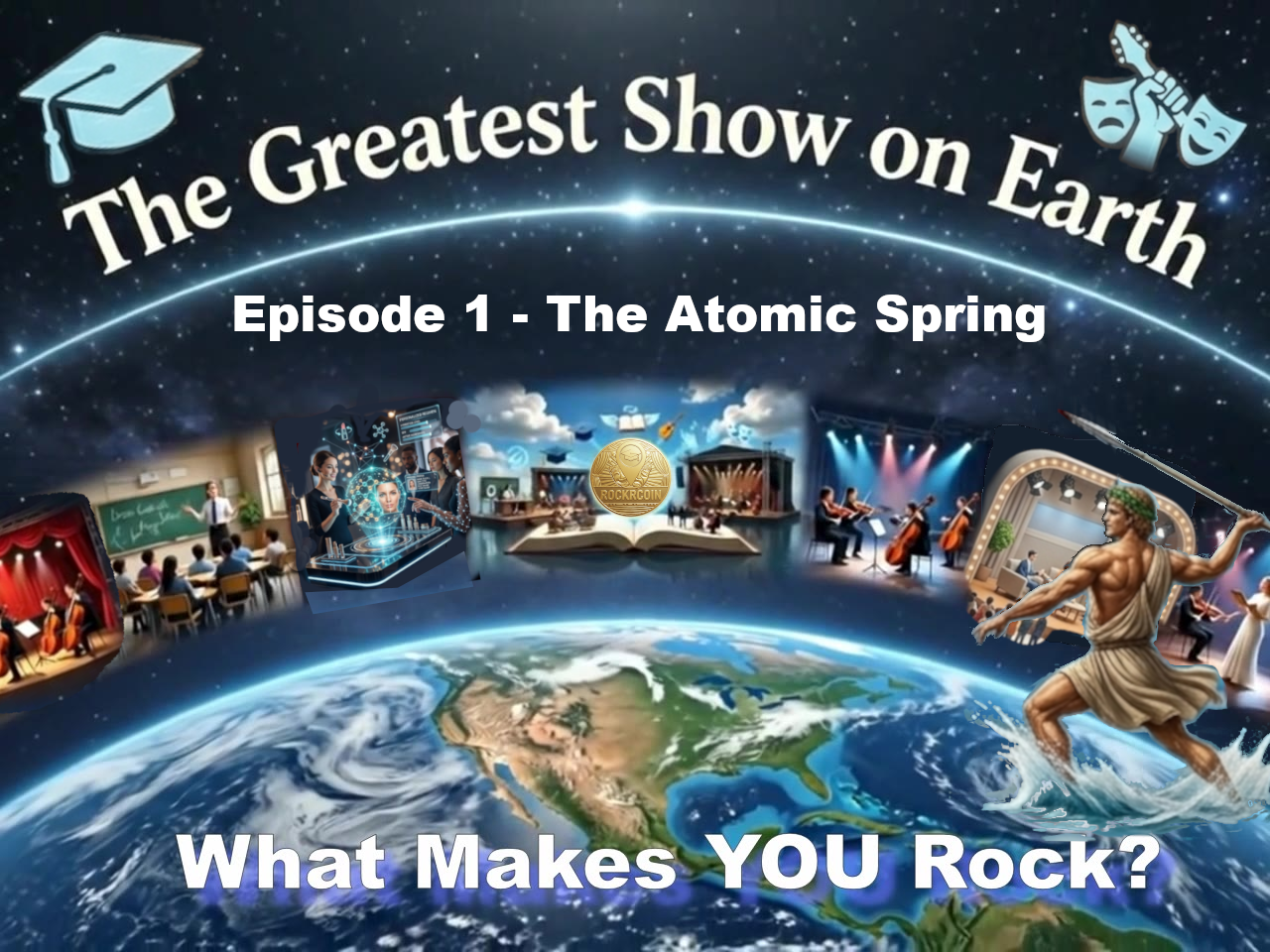
Episode One begins at the smallest possible scale: a single, invisible exchange between two verified strangers who cannot cheat each other. From that Atomic Swap — the subject of a live European funding application — the episode traces the ripples outward: an otherwise dark and unused town hall filling one evening; surfacing the value of human presence itself; a working prototype of — and laboratory for — a universal income with guardrails; and a collective approach the bond markets can countersign — because, in the end, they decide what nations can afford.
Narrated by founder David Clancy.
Read the transcript
Hello, and welcome to The Greatest Show on Earth — a podcast series about the question our century has suddenly decided to ask: in the age of artificial intelligence, robots and drones and infinite synthetic content, what is a human being actually worth? Today, that question has stopped being a typical rhetorical launch pad for one philosophy or type of politics or another, and started being existentially economic, for all of us.
These episodes are about one answer to that question — a decentralised answer, built not from speeches but from architecture. A project that begins with the smallest possible transaction between two verified strangers and ends, if it succeeds, with the largest possible claim: that the most precious asset in a world of intelligent machines is us. Humans. Live, together.
We are The Greatest Show on Earth — and yet the show has never had an economy worthy of it. This podcast is about building one. First, the atom — a micro-transaction between two strangers. Then the molecules. Then the organism: a living, open-source creature whose only pulse is people gathered live — until the show that was always in us at last has its stage. A gift from Europe to itself, to the world, and to humanity.
In today's episode, The Atomic Spring, we begin where every awakening in nature begins: at the smallest possible scale. You'll follow a single, invisible exchange between two verified strangers who will never meet — and cannot cheat each other. You'll stand in a town hall that was dark most nights a week, as it fills. And you'll trace the ripples that spread from that atomic transaction — that one small pebble — through the ocean of value of human presence itself, to a working prototype of a universal income, and out to the bond markets that decide, in the end, what nations can afford. An awakening that begins, as you'll hear, too small to be stopped.
I am David Clancy — typically European, in that I have roots and family in several European countries. As the name suggests, my parents were Dubliners. One of my sons and his family live there; the other in the UK, with his. I was born and bred in the UK. I read economics, philosophy and politics at Oxford. I worked in the City for US, Swiss and Japanese institutions. I went on to build and lead a technology company of over a hundred and twenty people, whose work reached a million students — and I have spent the years since asking how technology might actually be made to work to galvanise and nurture what it is to be human.
Today, I live and work in France. My daughter and her family live in the same village in the Bordeaux region. I am the founder and architect of the project these episodes describe: ROCKR, and its settlement layer, ROCKRCOIN — the Rainbow Digital Utility Asset. Zero-speculation, eco-friendly, just... and a probably unique, non-anonymous, consumer-facing blockchain that exists solely to serve a real economic need. Over this series, I'll take you from a single atomic exchange to the consortiums of universities, researchers and regions that I am gathering around it — and we'll ask why the whole endeavour may matter to anyone who has ever wondered what the machines will leave for the rest of us to be.
Episode One: The Atomic Spring
AI, robots, drones, social media, energy, the internet, food and water. If there is one thing that has become obvious to everyone in recent years, it is that independence in all of these, for every region in the world, is a strategic and regional security necessity. We can say regional because no single country — with the exception, perhaps, of the USA, China and India — has the critical mass to go it alone. For most other countries, regional co-operation is the only way of achieving national security. As Mark Carney, Canada's Prime Minister, said in so many words: the population of the USA, China and India might be three billion, but the population of everywhere else is five billion. So let's begin co-operating.
History has a habit of naming the moments when that instinct stirs in ordinary people. The Prague Spring... the Arab Spring... seasons when a population woke together and reached for something new. Those springs began in the squares of capital cities — and history records how easily squares can be cleared. The awakening this podcast describes begins somewhere far smaller. Too small, in truth, to be cleared at all: at the scale of a single exchange, between two human beings — and it grows upward, and ripples out, from there. Call it... the Atomic Spring.
In Europe, there are many strands running towards this objective already. Let's consider them for a moment, because each is a green shoot of this same Atomic Spring. A ninety-five-billion-euro research programme — Horizon Europe — quietly funding thousands of laboratories to close the technology gap. An Innovation Council seeking out the deep, risky science that venture capital will not touch. A movement called the Next Generation Internet — NGI — planting hundreds of small, open-source projects like seedlings in a forest that has been logged by others. A digital identity wallet, soon to sit in the pocket of every European, owned by the citizen and not the platform. A payment system — digital cash, built as free software, championed by central bankers — that lets a European pay a European without, for example, an American intermediary taking notes. Sovereign clouds rising across the continent. In the UK, an advanced research agency asking how we might mathematically prove that our most critical systems are safe. Many strands. One instinct: that five billion people should not be tenants in their own digital home.
A common theme in many research projects is how to achieve a self-sustaining, consumer-facing critical mass in any proposed solution, when the competition from the USA and China in particular operates a pincer movement which overwhelms local markets — whether that be in solar panels and electric cars, or information technology, with AI, social media, web services and all the rest.
It is into this space that this podcast speaks. The focus of the particular solution it proposes might seem, initially, to be narrow — even tangential to the global issues touched upon here. Surprisingly, the ripple from this pebble of a proposal spreads out to unexpected places — even to encompass collective approaches to the seemingly distant and unrelated world of the all-powerful bond markets.
To begin, then, at the beginning. Consider an exchange at the smallest level. An atomic swap. Bear with me just for a minute — it sounds technical, because it is, but soon spreads to something truly amazing.
Now — an atomic swap cannot be seen. No camera has ever filmed one. The two people it happens between will never see it either. It lives in the one place a podcast can take you better than any screen: the mind's eye. So build it with me.
Somewhere in Europe, at this very moment, two human beings are about to trade. One of them holds a digital coin, earned — as we shall see — by doing something irreducibly human. The other holds euros, or any other currency — ordinary money — and wishes to acquire that coin. Neither has ever met the other. Neither ever will. And yet, in the next few moments, they will complete an exchange in which cheating is not merely forbidden. It is impossible.
Listen to how it is done.
Before either party may so much as approach this exchange, the network has asked a single question of each of them — the only question it ever asks. Are you a verified human being? Not: are you rich? Not: are you anonymous? Not: what will you pay for the privilege? Simply: has a trusted verifier, somewhere in the off-chain world, confirmed that you are a real person — once, carefully, with documents and a face? If the answer is yes, a small cryptographic tick appears against that person's identifier on the shared ledger — the blockchain; the ROCKRCOIN, in this case, blockchain. An attestation, the engineers call it. Notice what it does not contain. No name. No passport. No photograph. The ledger — this permanent, unchangeable public record — learns only that a verified human being stands behind this key. It never, ever learns who.
This is the first wonder of the arrangement, and it is worth pausing on. Every wallet on this network belongs to a verified human — and yet the chain itself holds not one byte of personal information; personal data. Accountability without exposure. Should a court one day lawfully require to know who stood behind a transaction, the answer exists — held off-chain, under Europe's data protection law, by the verifier. And should that human one day ask to be forgotten — as European law says they may — the off-chain record is erased, and the tick on the ledger becomes an unresolvable cipher: a fossil with no living creature attached. Their coins, curiously, survive untouched — for the coin answers to a key that only the human holds. Immutability, and the right to erasure, living together. And should the human lose their key, they can still reclaim their coin, by going through a process with their trusted verifier in the off-chain world.
Now — the swap itself. The coin-holder's asset is locked by the network: visibly committed, unspendable, held by no one. Simultaneously, the euros — or the other currency — travel, and here Europe's own digital cash makes its entrance. The money comes to rest in an escrow: a neutral holding service, rather like the solicitor in a house purchase who keeps the deposit until the keys change hands. But here is the elegance. This escrow never owns the money. It cannot run away with it, for the design gives it holding without possession. And the payment rail itself — this is the subtle part — is engineered so that the payer's banking identity does not travel with the payment. The protocol already knows both parties are verified humans; the plumbing has no need to know it too. Private from the rail, never anonymous to the protocol. Verified where it matters; invisible where it doesn't.
And then — the moment. Both sides stand prepared: euros held, coin locked. And the mechanism does the only thing it is capable of doing. Both release together, or neither releases at all. There is no sequence in which one party has paid and the other has fled. The exchange is atomic — indivisible, like the particle that lends it its name. If anything falters — a timeout, a failure, a change of heart — the whole arrangement reverses. Euros, or the other currencies, home to the payer; coin — ROCKRCOIN — home to the seller, as though the encounter had never occurred.
Now ask the question a financier would ask. Does this liquidity — this ability to move between coin and euro, or any other currency — not open the door to speculation? To the boom, the bust, the anonymous whale? Could a verified human not simply buy the coin, and hold it, and hope? Of course they could. But follow that speculator in, and watch what they find missing. Here, the design shows its teeth. There is no scarcity to bet on: the supply of this coin grows with human activity itself — every coin in circulation is a receipt for something real; never sold, never mined, never printed at discretion. There is no crowd to hide in: since every holder is a verified human, there are no anonymous pools — every hoard visible, every stolen coin unspendable forever. There is no leverage to feed on, for this coin cannot be borrowed into existence: no margin, no credit pyramid; every unit in circulation earned, or paid in full. A speculation, you see, is a herd animal. It needs scarcity to excite it, anonymity to hide it, and borrowed money to feed it — and each of these, the design has removed. A lone speculator may wander in, and wait, and slowly grow bored. But a boom has nothing here to feed on. A bust has nothing to collapse. Liquidity, yes. A market, yes. A mania? The speculative habitat is simply gone, in this Atomic Spring.
This single exchange — this atom — is the subject of a funding application which will soon sit — this month, July 2026 — with Europe's Next Generation Internet programme (NGI): to build the escrow as free software, on Europe's own payment system, and give it away, so that any platform on the continent may use it. A small grant. A single cell. But every organism you have ever seen began as one.
And what, you may ask, is this coin a receipt for? What is the verified human activity at the bottom of it all?
Come with me.
It is evening, in any European town. In a hall that stands dark most nights of the week, something is gathering. A teacher, or a musician, or a chess master, or a chef, an author — the possibilities, in every live experience type and genre, are endless. This teacher proposed an experience on their phone some weeks ago. They completed nine simple steps, using the local football team's instance of ROCKR's open-source app — with that app's stack's artificial intelligence absorbing all the drudgery. So the venue is found, the terms set. And then, the remarkable part: the experience was funded by the ROCKR auction — dozens of people committing a portion of their weekly ROCKRCOIN allocation until, and only when, the whole was funded, did this new live experience become real. No deposit risked. No organiser ruined. No hall hired on a wing and a prayer. No marketing spend. The friction that has strangled a million small or large gatherings — the upfront cost, the legal exposure, the fear — all engineered away.
And notice something about tonight that no technology can imitate. A live performance is, by its very definition, a non-anonymous occurrence. You cannot attend a concert anonymously to the people in the room. Presence is disclosure — that is the whole point of it. These people have chosen to be here, seen, together. The network's architecture — pseudonymous by design — records nothing the room does not already know, whilst fiercely protecting the anonymity that does matter. To the wider world, the ROCKRCOIN blockchain ledger publishes only aggregates: how many people, in a region, might welcome such an evening. Counts, and availability shapes. Never names. Never calendars. A person steps out of that anonymous crowd exactly twice — and to two different audiences. Once to the network, weeks before, at the moment they chose to bid — the moment their verified wallet, and never their name, raises its hand. And once to the room, tonight, at the moment they walk through the door. To everyone and everything else — every platform, every advertiser, every watching algorithm — they were only ever a number in a crowd.
And here's the even more remarkable part. When the evening ends — when the network's authentication layer has confirmed that real humans genuinely gathered, in that place, at that time — the ROCKRCOIN protocol issues new coin, to the audience side and the supply side alike. Value, created for everyone, at the instant of human aggregation. This is the weight — the gravitas — inside the pebble, and the reason so small a stone can send its ripples so far.
In a world where artificial intelligence looks like it's going to write, calculate, design and think — albeit computationally — better, faster, cheaper, the young — the canaries in this minefield — sense, indeed they have been told, in words later retracted but not unheard, that their value is their labour, and their labour is being outbid. Some have already stopped singing. All of them are asking: what is a human for? What are we for? But each human carries something that many eminent scientists argue no machine will, by definition, ever demonstrate. A self-aware consciousness. A unique vantage point in the universe. A GPS coordinate of experience that exists nowhere else, and can be copied by nothing. If one such consciousness is precious, then a gathering of them — in person, in real time, in a shared space where consciousness encounters consciousness — is the most precious asset in the world. This is not sentiment. In this design, it is the ripple. It is the monetary policy. The only mint in the entire ecosystem is the result of the live aggregation of human beings. Because the value of being human — of being who we are — is not defined by the colour of our hair, our skin, how many limbs, digits, eyes, ears or hearts we have; nor by our sex, or nationality, or even by what we believe in and think. It is overwhelmingly about the extraordinary manner, and the phenomenal extent, to which we are consciously self-aware. All of us.
Now let's project, and multiply tonight's little hall onto the world. If two billion people attended merely two live experiences a month, at twenty dollars' ROCKRCOIN equivalent each, the settlement flowing through such a network approaches a trillion dollars a year, equivalent — Education, the Arts, Community, Sport, the High Street, Health, and their entire supply chains behind them. There is the answer to Europe's critical-mass problem, hiding in plain sight. Not an attempt to out-build the giants at their own game, but a market the giants have never served: the market for being there — native to every town in every region, growing from the ground up out of spare capacity the world already owns but doesn't use. The dark halls, abandoned shops, forgotten spaces, schools designed a century ago, threatened theatres; the empty mornings, solitary lunches, and doom-scrolling evenings; the unmet demand, the wish to gather, the wish to teach what students have designed themselves, and opted in, to learn; to entertain, to amuse, to be amused. All of it waiting on the pebble — about to drop, and ripple, through that ocean which is humanity's unique presence: individual, and collective.
And two further ripples, before we close, spreading wider than you might expect.
The first: every verified participant in this network receives a weekly allocation of ROCKRCOIN, on a use-it-or-lose-it basis, spendable on one thing only — backing and attending live human experiences. Attend — genuinely, verifiably — and the coin you committed moves to your main account, where it is money like any other. So it is earned by participation, extinguished by hoarding, and impossible to speculate with. Consider it carefully, and you might recognise what it is: a small, working prototype of a universal income — one with guardrails, anchored not to the printing press but to verified human activity. Not a promise of one — a universal income — a laboratory for one.
The second ripple reaches the very bond markets in which I used to work — those vast, planetary, seemingly inert moons that push and pull the oceans of human activity, in tides that decide, in the end, what nations can afford. Any single country that attempted, alone, to surface and guarantee the value of its people in the age of AI and automation would print, and borrow, their overburdened and not-fit-for-this-purpose fiat currency — and the tide would go out on its bonds, stranding them as outlier bonds, from a nation that went it alone. But a mechanism operated in unison — many countries, with one shared, verified settlement layer, whose unit answers to no single nation's currency and to no printing press, but to real, verified human activity, adjusted to the cost of living of each place — is a different creature entirely. Co-operation is not only, as we said at the beginning, the path to security. It is the only signature the bond markets will countersign — albeit by default: if the pebble's ripples reach everywhere equally, there are no especially dangerous waters for the bond markets to fear, and avoid.
In conclusion, then. Our canaries are beginning to stop singing. By developing this pebble — the atomic swap, in this Atomic Spring — and dropping it into the ocean of live human activity of every genre and type, we will set in motion the benign ripples, to reach far and wide, in many unexpected but welcome ways; and to answer the canaries' question, and to prove to them — in architecture, in cryptography, in monetary policy, and in action — that their value was never really about their labour at all. It is their presence. It is their consciousness. The self-aware consciousness of us all, gathered live, together.
This Atomic Spring is a renewal — an affirmation — of what it means to be human.
It is going to be The Greatest Show on Earth.
Us. We humans. Live.
Prefer episodes delivered to your podcast app? Ask me and I’ll send you a personal feed invitation.